

Not Gravel Or Turf: A More Charming, Weed-Resistant Landscaping Option
The search for a beautiful ground cover that doesn't promote weed growth is one that every landscaper has to face eventually. Gravel and mulch are common go-to options, but they can get messy if they get overgrown with weeds. Turf is also vulnerable to weed growth, especially in areas where the lawn weakens and turns brown for lack of sun or water. In shady areas of the yard where turf clumps and struggles to grow, mood moss (Dicranum scoparium) — a species that thrives in USDA hardiness zones 1 to 7 — is an opportunistic alternative. When it's healthy, it can also prevent weeds from overgrowing in these areas.
Moss doesn't steal nutrients from grass or weeds, and in fact, healthy turf will outcompete it. Moss lacks actual roots, and attaches itself to surfaces with spindly structures called rhizoids, so it can grow in areas with soil that's too infertile, acidic, compacted, or too poorly draining for grass to grow. These are the same areas that weeds tend to overtake, and cultivating a moss cover in these areas creates a thatch that deprives weeds of the sun exposure they need to germinate.
Of course, many gardeners consider moss to be a weed itself and look for ways to prevent it from encroaching on the lawn. However, this attitude ignores the many benefits that have been appreciated in Japan and elsewhere for centuries. Moss is low-maintenance and never needs mowing, it won't become a meal for deer and other scavengers (they hate it), and it can survive even the coldest winter. It also absorbs water and stabilizes the soil.
Choosing and using moss in your landscape
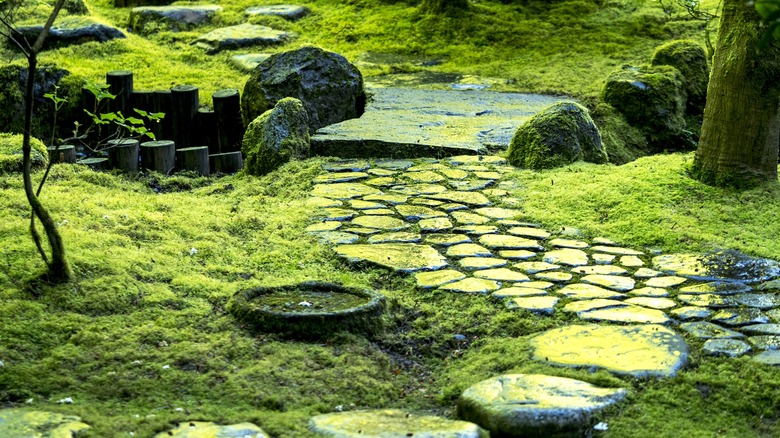
Moss isn't just for ground cover. The ability of acrocarpous species to grow vertically and fill space more like a bush than a lawn makes them great decorative features. Mood moss is a prime example. Common in the Great Lakes region, the Appalachians, and the Pacific Northwest, it grows in dense clumps from one to five inches tall and is valued for its lush, green foliage. This moody moss tends to turn brown when water is scarce, but it quickly recovers when re-watered. Weeds may compete with it, especially when it's young, so you'll still have to pull some of those, particularly in the spring when growth is vigorous.
However, there are 12,000 moss species that exist worldwide. Of these, some creep along the ground (pleurocarps), some grow vertically (acrocarps), and while most prefer shady, moist locations, some can tolerate partial to full sun. Sun Moss (Racomitrium moss) is a lime-green pleurocarp that's a popular ground cover for sunny lawns. Bryum moss (Bryum caespiticium) is a related species with a similar hue and sun tolerance, but unlike Sun Moss, Bryum moss turns brown during dry spells, rebounding when it's watered.
If your lawn has partial to full shade, you have more options for mossy ground cover. Sheet moss (Hypnum curvifolium) is a grass alternative that commonly grows on forest floors throughout most of the world and can handle four to six hours of sunlight a day. Carpet moss (Hypnum cupressiforme) is a related species that provides a dense, green, and very walkable alternative to grass.