

Vintage Blanket Could Turn Out To Be A Designer Antique Worth Hundreds
If you've ever wandered through an estate sale, thrift store, or the boxes in your grandmother's attic, you've likely stumbled upon some quilts and wondered if they had any kind of value. As it turns out, vintage quilts are one of those valuable collectible items you shouldn't overlook should you happen to come across some. In fact, there is a decent chance that the vintage quilt you've stumbled upon could be worth hundreds or thousands of dollars.
A quilt is a type of blanket that sandwiches an insulating filling between two pieces of fabric. The fabric is often stitched with intricate patterns that can reflect the era in which the quilt was made. While there are plenty of places to buy new quilts, handmade quilts from the 1800s to 1940s are sought after for their historical significance, quality, and decorative patterns. Basic, two-color quilts with simple patterns were common, as were more intricate prints that came about due to advances in printing and color technology.
But what kind of value can you expect from quilts like these? On average, vintage quilts like these often sell for $150 to $450. However, it's not uncommon to find era quilts online auctioning for well over $1,000, with quilts that can be traced back to the American Civil War being worth closer to $8,000. That dusty quilt in grandma's attic might be worth more than you think.
How to identify a valuable vintage quilt
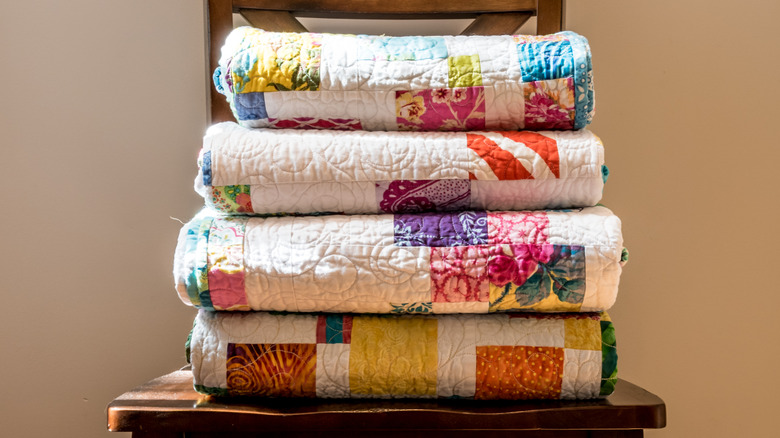
Now, it's all well and good to locate a vintage quilt to store in that antique hutch you just bought, but you also need to know what makes it valuable. First, it helps to know who designed the pattern. While many handmade quilts can be totally original designs, one important quilt designer was Marie Webster. In the early 20th century, many of her popular floral patterns were sold as kits for people to make at home.
Another indicator of value in a vintage quilt is the fabric from which it is made. Quilts made from historically significant fabrics often hold more value. Sacks for dry goods such as sugar, animal feed, or flour were made from woven cotton in the late 19th century and well into World War II. These sacks, which often came with their own printed patterns, would be repurposed as quilts, and even dresses. You can find examples of these online that are worth around $300.
Finally, there is the stitching. Machine-made quilts will have even, uniform stitching, whereas handmade ones will have closer stitches that form more intricate patterns. Handmade quilts are often more desirable to collectors because they showcase a greater degree of craftsmanship and detail.