

What Happens When You Fill Lawn Mower Tires With Foam?
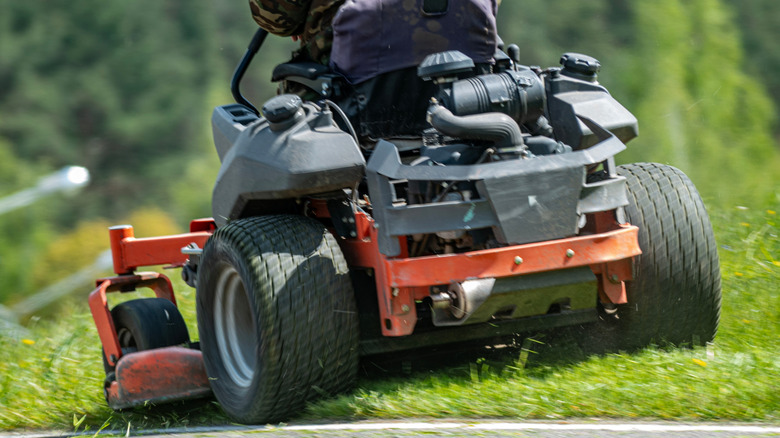
We may receive a commission on purchases made from links.
If you've been bothered with consistently flat lawn mower tires but don't fancy paying hundreds or even thousands of dollars for airless replacements, have you considered filling your tires with foam? If spray foam can keep sidewalk pavers from sinking, filling lawn mower tires with foam should mean you won't have to worry about flats ever again. But what actually happens when you do it?
YouTuber Mower Mike has a series of videos on how to fill lawnmower tires with foam. He uses Great Stuff Gaps and Cracks, which is a minimal expanding polyurethane foam, which works well for the job. In one video, Mike demonstrates what the inside of a tire that's been filled with foam looks like, by cutting away the rubber. Essentially, it is a solid interior tire that has filled any holes or air gaps that may have been present. The foam has bonded to the metal wheel, so it's not just floating freely inside of the tire.
In terms of how much foam needs to go in for this to work, it varies based on the kind of tire you're trying to fill. For smaller 8-inch tires on a traditional push mower, 20 to 30 seconds of filling will do the job. For larger tires, such as on zero-turn models, Mower Mike says an entire can should be more than sufficient. Costing around $5 per 12-ounce can, using the foam is certainly a much cheaper alternative than a new set of tires. But does it actually make a difference?
Foam is a quick fix, but might not last long
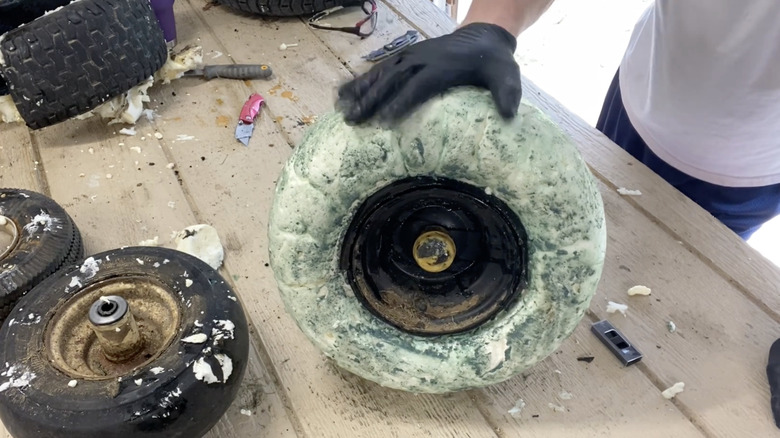
Unlike using a pool noodle to make the handlebar of your push mower more comfortable, filling your lawn mower tires with spray foam is a quick fix that might not last as long as you think. In a follow up video, YouTuber Mower Mike showed that, after two months of use on his zero turn mower, the foam he'd sprayed inside of his tires disintegrated. It also looks like water leaking might have been an issue, which is something expanding foam should be able to prevent. So, while its a quick fix up front, it doesn't seem to last long.
Two other issues may be weight and ride quality. Solid foam skid steer tires, for example, add a lot of weight to the machine, which can put pressure on the drivetrain. And because the tires are stiff with foam, they create a much bumpier ride. While the type of foam you fill your mower tires with won't be that heavy duty, you're still adding weight and stiffness to the tire. Therefore, it stands to reason that you could experience similar problems. Then there's the added work of removing an old tire and solid foam from rims if you hope to reuse them.
An alternative to foam is a product called TireJect, made from aramid fibers (found in Kevlar) and recycled rubber. When sprayed into the tire through the valve, then spread around the interior by spinning the tire, TireJect seals any holes and leaks, maintaining air pressure while also preventing future punctures. It should help keep your tires from going flat for a long time to come.