

Skip The Metal File: There's A Smarter Way To Sharpen Lawn Mower Blades
We may receive a commission on purchases made from links.
Let's face it, the maintenance required when it comes to lawn care equipment, including your lawn mower's blades, isn't easy. However, keeping these under-appreciated grass choppers in tip-top shape ends up being worth the effort. Dull blades chop, shred, and fray grass blades, and impede healing compared with the clean cuts sharpened blades make. And according to Cornell's College of Agriculture and Life Sciences, dull blades also increase your fuel usage by as much as 20%. For a long time, the best DIY sharpening method was to break out a metal file and hand-sharpen each blade. Luckily, there's a smarter way that you probably already have hanging out in your garage: your Dremel rotary tool.
Like a lot of lawn care tools, lawn mower blades tend to dull with use and need to be sharpened once in a while — usually at the beginning of the season and every 20 hours of mowing after that. Sharpening by hand with a file is laborious, it's easy to get the angle wrong, and they're best for small nicks and light sharpening. What makes a Dremel a smarter choice is that the tool is doing the hard work for you, in an easily controlled manner.
What makes a Dremel better for sharpening your lawnmower than a file
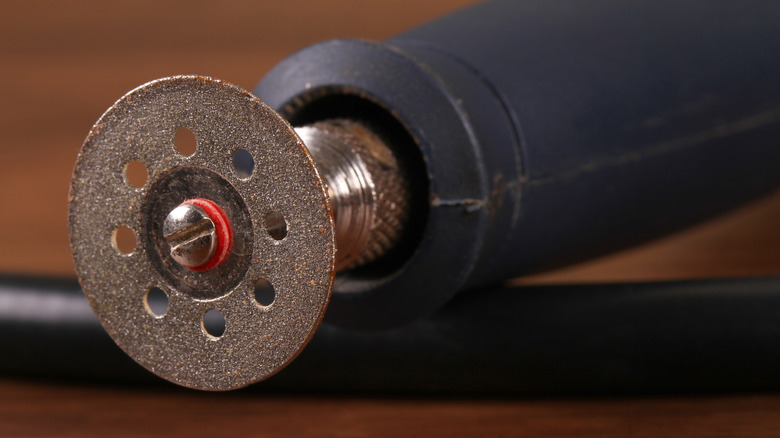
First, we should say, yes, any rotary tool will work. In fact, the Sharp Pedal cordless blade sharpener is another smarter way to sharpen lawn mower blades. Dremel is a popular choice with many experienced fixit folks, because it's readily available, relatively cheap — the bare bones, single speed 7350 4V Cordless Rotary Tool Kit is less than $30 — and has tons of specialized accessories. In particular, the Dremel 932 attachment is specifically designed to accurately and efficiently grind, smooth, and sharpen metal. The kit also includes a plastic guide attachment for lawn mowers. If you're familiar with the brand's 675 attachment for sharpening lawn mower blades, it's worth knowing that product has been retired.
The reasons rotary tools work better than a metal file come down to speed and precision. With a metal file, you need to grind it against the blade's edge in a downward motion so it's really easy to accidentally cut yourself. And it takes quite a long time to get a clean, consistent edge. In contrast a rotary tool eliminates that up-and-down manual motion and lets the tool do the work for you, making it a safer way to sharpen lawn mower blades. The rotary tool's motor can do in seconds what it takes you many minutes to accomplish with a file. What's more, the same grinding tool can be used on countless DIY projects, from smoothing rough or rusted pipes, to refurbishing vintage wrought iron garden furniture.
How to safely sharpen your lawnmower blade with a rotary tool
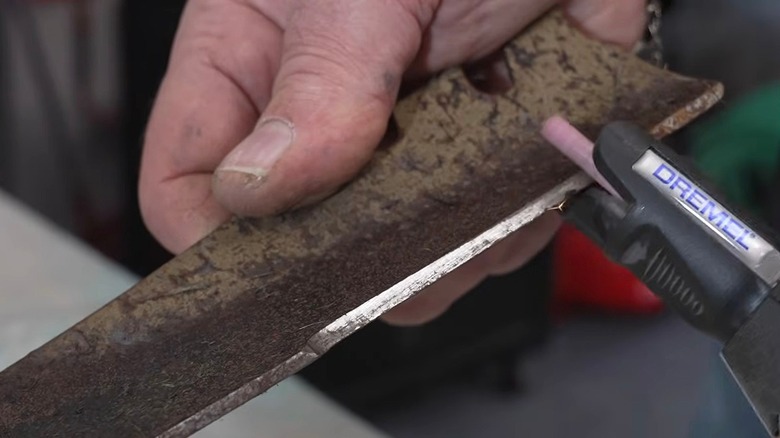
To start, eye protection and gloves are essential safety gear, but you may also want ear protection. You'll also need the right equipment to remove your lawn mower's blade from the machine, a vise, one nail, and the Dremel A679-02 sharpening attachment kit or your rotary tool's equivalent.
Put on your safety gear and remove the blade from your lawn mower according to its manufacturer's recommendations. Marking the down-facing front edge with a Sharpie or a bit of blue painter's tape will help you reattach it the right way. Next, clamp the blade tightly into a vise and clean off any dirt or debris so you don't have bits of soil or grime flying everywhere. Insert the 932 sharpening attachment into your Dremel, set the speed to 25,000 rpm, then grind the stone against the blade's beveled edge. Adding the plastic guide helps make your angle even more accurate. Don't over-sharpen it as this can make it dull faster and more susceptible to chipping if you hit a stone. The blade really it only needs to be as sharp as a good butter knife. Turn the Dremel off, flip the blade over in the vise, and repeat on the other end.
Once you're done, remove the blade from the vise and put a nail through the hole in the middle so the blade looks like a horizontal plane propeller. This ensures the blade is balanced. If it stays level, you're good to go and can return it to your mower. If one side tilts down, though, it's too heavy and needs one more go with the grinding stone.