

What To Do If You Find Mice In Your Attic

Cinderella may have become close friends with the mice living in her attic, but today's homeowners know they're more likely to cause problems than help pick out the perfect party dress. Although there are some ways to deter mice from your home and yard, they don't always work. In fact, according to the National Wildlife Control Operators Association, a staggering 95% of homes nationwide have mice nesting in their attics. It makes perfect sense if you're a mouse, since attics offer cozy surroundings and a place to hide from predators. While they may not be boldly heading into your kitchen to grab a few plates full of last night's ratatouille, you might realize you have them when you notice a half-chewed food wrapper on the floor, or worse, a few of those telltale brown, rice-like droppings.
In an exclusive interview with Hunker, Josh Petro, Operations Manager at Truly Nolen, said homeowners should act quickly to avoid serious damage, health risks, and costly infestations. "If you get mice in your attic, you should inspect and exclude your home in a timely manner. Mice can contaminate an area, chew wires, and spread disease over an extended period of time if the problem is not handled quickly," he explained, adding, "Homeowners should exclude the home, Air Conditioning Chase, soffits, gaps, and even their vent stacks on the roof."
Unfortunately, poison and glue traps only solve half of the problem. Exclusion involves sealing any gaps or cracks where mice are coming into your home. If you plan to DIY, summer is the ideal time since mice will head indoors once it starts to get cold.
You may have more mice than you think

If getting rid of mice is on your mind, you may have spotted a single one scurrying across your floor or had the unfortunate experience of eyeing several while moving boxes around in your attic. It's significantly cheaper to set out a few traps yourself than calling an exterminator, so you may simply approach the problem by baiting them with a little cheese or peanut butter, but these methods can be cruel and inhumane. Even if you've only seen a single mouse, how can you be sure another one wasn't hiding in the corner, watching his friend's demise go down?
During his exclusive interview, Hunker asked Josh Petro how homeowners can determine the level of mouse infestation happening in their attics. "One mouse caught over a week is likely isolated or a very small problem," he said reassuringly. It is possible for a single mouse to simply take the opportunity when a door is left open or hitch a ride inside a cozy bag of mulch from your local garden center.
However, given the statistical probability that there's a mouse in your attic right now, it's just as likely you'll encounter a more serious infestation. "One to three mice per night would be an active infestation, and continued catches for two-plus weeks means a larger hidden population is likely nearby," Petro explained. Mice can climb vertical surfaces, jump higher than you might expect, and slip through tiny cracks you may not even know you have. Worse yet, a single mouse can have between five to 10 litters each year. In other words, if you spot one in your house, there are probably others nearby.
Serious mice infestations require professional help
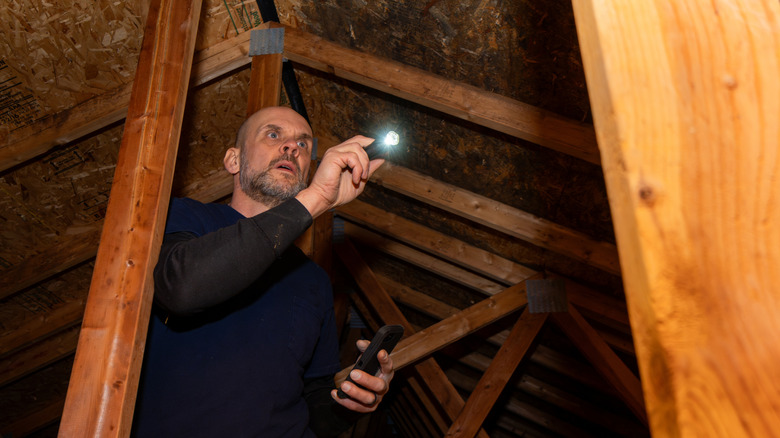
So, should homeowners handle a mice infestation in the attic on their own? Or, are pest control services really worth the money? According to Josh Petro, the right way to handle your situation depends entirely on how severe the infestation really is. "Homeowners can handle a small mouse problem themselves, especially if they catch it early," he told Hunker during his exclusive interview. Along with traps, remember to seal up even the smallest cracks or entry points. Plus, you'll want to throw away any potentially contaminated food, thoroughly disinfect all food prep areas, and wear a safety mask and gloves when cleaning up mouse droppings.
However, if you find yourself constantly playing cat and mouse with vermin in your attic, it's best to call an expert for help. "[Homeowners] should call a professional when any of the following occurs: they keep seeing mice after trapping, they hear movement in multiple walls/ceilings, they find nests or baby mice, they suspect rats instead of mice, or they recognize the infestation has lasted more than a few weeks," Petro said.
Even if you're poor as a church mouse, the damage mice can cause by chewing through your electrical wiring can be far more expensive than hiring an exterminator. According to Angi, the average cost is between $180 to $555 for extensive trapping and exclusion work. Along with asking general vetting questions about the company, client testimonials, and warranty, you should ask for detailed information about the exact areas that will be excluded, whether cleaning and sanitization of infested areas is included, and if there are any risks to household pets from poisons, baits, or traps.