

5 Kitchen Tools That Work Perfectly In The Woodshop

We may receive a commission on purchases made from links.
The "secret" transport of tools and supplies traveling from our kitchen to my workshop has long been established. As an expert woodworker with decades of experience, this crossover use for kitchen gear is so ubiquitous that I don't even think about their primary use when I'm grabbing, say, organized measuring cups to create (and subsequently record) a ratio for properly thinned paint in my spray gun. Woodworking and kitchen work are kindred spirits in some ways: Manual labor for which human ingenuity has come up with tools and products to make those tasks easier. So, while using kitchen items in a woodworking shop may be a curious idea, it is not truly surprising.
On the other hand, I cannot think of a tool that has moved from the woodworking world back to the kitchen, with the exception of certain cutting and chopping tools. But who is to say the woodshop or kitchen was the chicken or the egg in this scenario? For centuries, essential kitchen tools like spoons, rolling pins, and spatulas were made in the woodshop. Regardless, the kitchen is an endless source of shop supplies, with things like plastic cling wrap, roasting pans, even egg beaters readily available. Here are five items that I use in the shop that were originally intended for the kitchen.
Eggbeaters blend more than just eggs
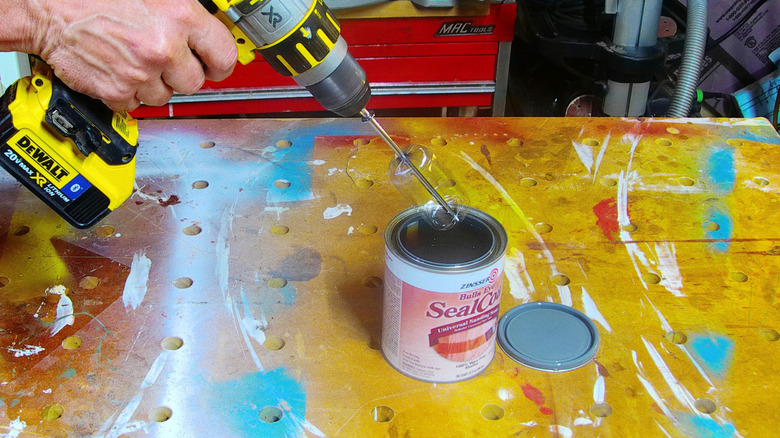
Even in the kitchen, eggbeaters (we're not talking blenders) do more than just whip up eggs: They cream butter and sugar, mix up batters, and so on. In the woodshop, they are handy for their ability to mix or stir liquids. If you open a paint can and the components have separated, you need to vigorously stir the contents to get the paint back to a usable consistency. Even many clear finishes benefit from being stirred before use. Those thin wooden stir sticks get the job done, if you don't have anything else to do that day or your wrist and forearm are in need of extended exercise. A beater attachment from a kitchen mixer is a much more convenient tool for this task. You can mount it in your drill driver, and it is small enough to use in pint and quart cans. Your drill's RPM variability adds to the effectiveness. You can also use a beater attachment to mix two-part epoxy or even powdered joint compound with water. Just be sure and ask before making off with this tool, if someone else runs the kitchen. As a side note, a reader of mine once decided to mount a beater in a handheld router. Just don't.
Measuring cups are ideal for two-part adhesives and finishes
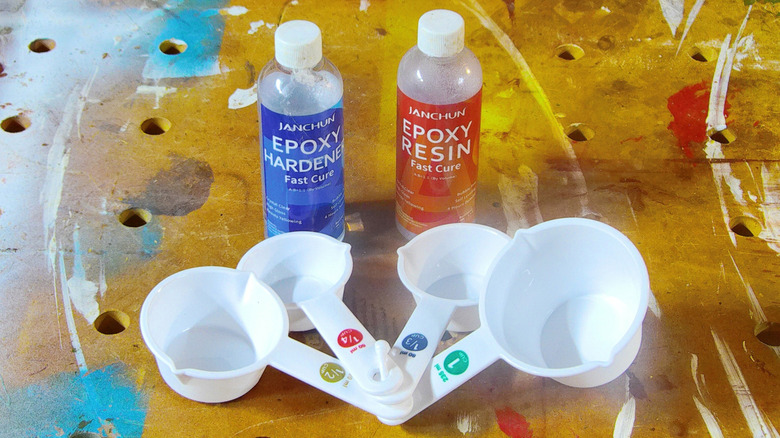
Epoxy resin has become a super-popular product in modern woodworking shops. It's used as an adhesive, providing a powerful, waterproof means of gluing pieces of wood together, and as a design component in furniture construction, as with the Foevaflo olive wood custom river table, to create decorative "rivers" on tables. Epoxy resin is an effective wood sealant, used to create a final, hard-as-nails protective finish. Mixing the hardener with the resin in a precise ratio is critical to proper hardening of two-part epoxy. Measuring cups work well for this task. (As do kitchen scales, another kitchen product that can be used in the shop.) When thinning a finish, they provide an accurate volume of thinner to finish, so you can repeat the recipe later on. Measuring cups are also handy little cups to say, drop screws into and carry to a job in the shop.
Aluminum foil and plastic wrap to the rescue
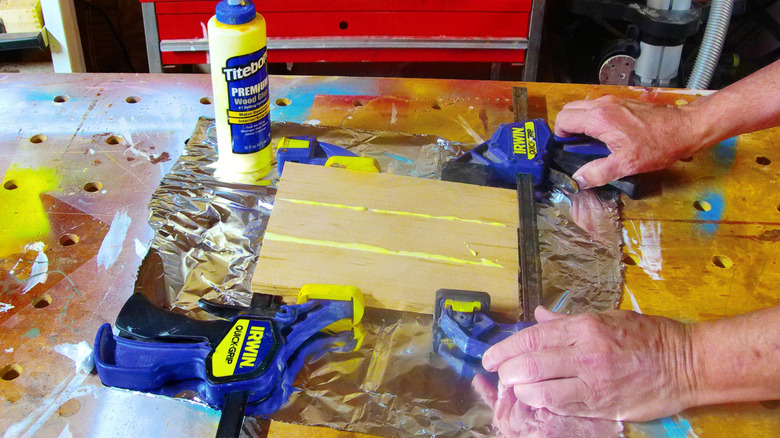
Not quite a tool, but the versatility of aluminum foil is legendary, and that versatility extends to the woodworking shop. One of its primary uses in the shop is as a barrier to prevent excess glue drops from bonding to a surface under a glue up. It may be, as shown above, just a sheet to catch drippings as you glue boards together. But it also works inside complicated furniture assemblies where you are gluing components in place, and you don't want the interior (of a chest of drawers or a cabinet, for example) to get fouled with glue drops. It can be molded and folded into small areas and pockets. You can use it to mask off areas where you don't want a finish, to protect a mortise for a glue joint, or act as a break between two colors of paint. I don't know how many times I've used aluminum foil to replace the plastic caps on cans of solvent or alcohol that I have lost, but it would be scores. While rolls of paper may work for some of these jobs, aluminum foil can be reused or recycled (check your local regulations).
I use a different sheet product from the kitchen to keep paint brushes from drying out between coats — plastic cling wrap, such as Saran wrap. I simply wrap the brush, paint and all, with plastic wrap and set it aside. If it is going to be overnight, I put the wrapped brush in the freezer. This way you only have to clean the brush once, and bristles don't stiffen and dry while you're taking a break for another task.
Roaster and baking pans have countless uses in the shop
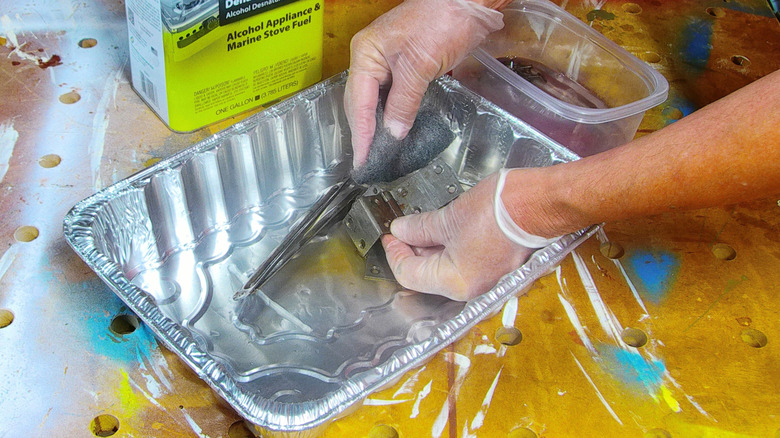
I'm currently restoring an antique cedar chest. One of the tasks is to remove rust and dirt build up from the chest's hardware, specifically the hinges and lid support. To do that, I soak them in a solvent then use steel wool to remove the crud and corruption built up from more than a century of use. That's where disposable baking pans come in handy. Their metal construction means solvents won't harm them and they are sturdy enough to hold up to any scrubbing. I used to wait until one of our regular roasting or baking pans were set to be retired from the kitchen, but now I often buy the inexpensive aluminum options. If they wear out, they are recyclable.
Another use for these shallow pans is applying finish to small items like treenware (all-wood kitchen utensils). For spoons and spatulas and the like, I prefer to soak them in mineral oil to seal the wood. These pans are perfect for this use.
Scissors and soft stuff are always on call
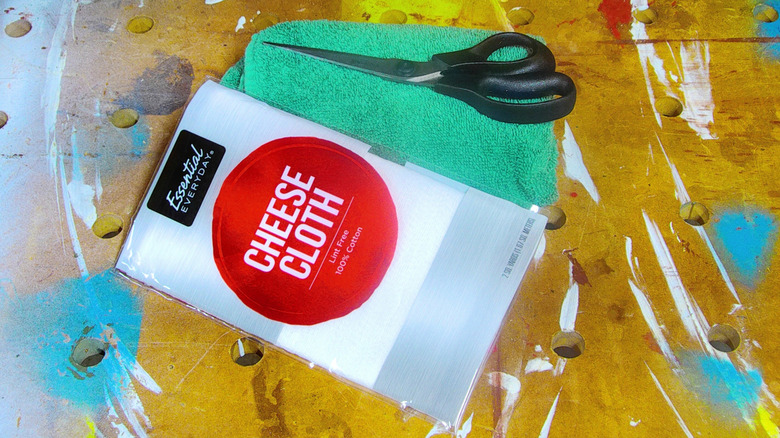
Okay, six items. Scissors are a must-have tool in the shop. In fact, I have several types of scissors that I make use of in my workshop. But one of the most useful is a traditional kitchen shear. They are a robust style of scissors that I've used to cut everything from strings and wiping clothes to electrical wire. I've even used them to cut through a sheet of veneer, but let's just keep that between us.
Finally, don't underestimate the strength of soft kitchen items. Cheese cloth is used to filter finishes or solvents that may have become contaminated with foreign particles or other impurities. It is also works as the traditional wiping "mouse" used to apply a fine French polish finish. Worn-out fabric hot pads make good clamp cushions and pads to prevent scratching a finished wooden surface on a rough workbench. Stained and worn kitchen towels serve in my shop doing everything from cleanup to applying stain.