

The New England Garden Secret You'll Want To Add In Your Own Backyard
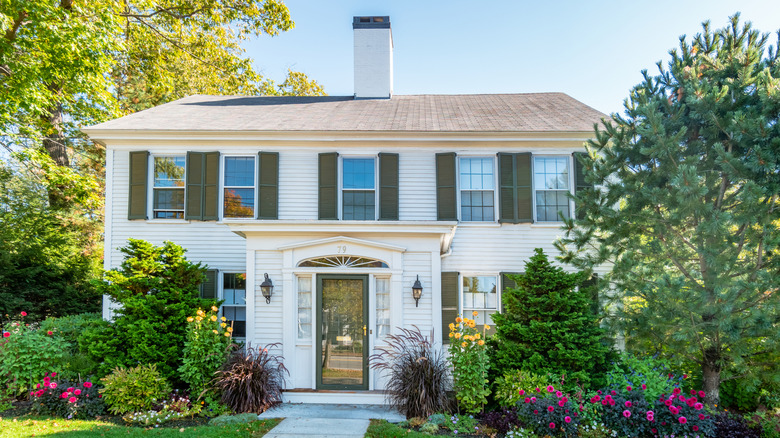
From their saltbox shapes to their odd yet practical diagonal windows, there is a lot to love about old New England homes, especially their gardens. Some classic New England garden traits, like white picket fences and flower beds overflowing with hydrangeas, are quite well known. However, there is one New England garden secret you'll want to know about that will totally transform your backyard.
Many traditional gardens in New England utilize elements of a formal French garden design known as parterre. Meaning "on the ground", parterre was introduced in the late 1500s in France, quickly became popular in England in the 1600s, and eventually made its way over to America in the 1700s. Parterre uses symmetry to create highly decorated garden spaces, often incorporating box hedges and flower beds separated by gravel-lined garden paths.
While the New England gardens inspired by parterres are not as ornate as the ones back in Europe, they do take cues from the design. For instance, they emphasize the symmetrical garden layout defined by paths between beds edged with trimmed boxwood and/or filled with fragrant flowers. One excellent example of this is the garden at the historic House of the Seven Gables in Salem, Massachusetts. Though its beds are built with wooden planks as opposed to boxwood, the symmetrical layout of the parterre tradition is evident throughout the garden.
How to incorporate parterre into your New England-style garden
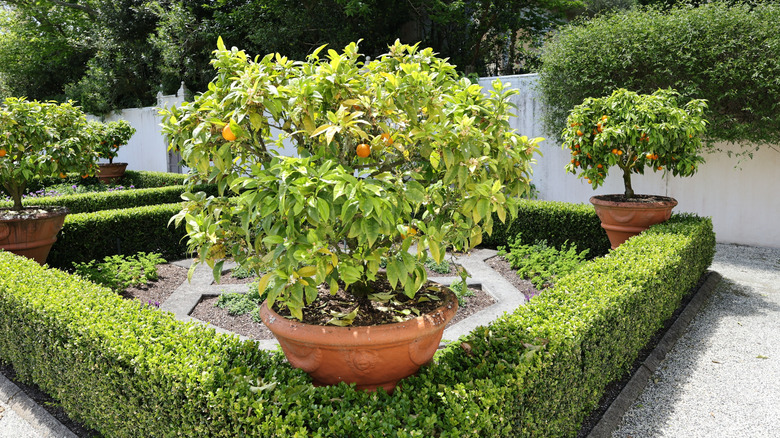
Parterre contains all six principles of landscape design – balance, focalization, simplicity, rhythm-slash-line, proportion, and unity. It can be incorporated into your backyard in a number of different ways to give you the New England garden vibes you're looking for. If you're seeking that clean, formal look, you'll likely see common boxwood (Buxus sempervirens) as a suggestion. However, this variety is a tad too sensitive to boxwood blight, a destructive fungal disease that is common in New England. Instead, use the hardy Winter Gem (Buxus microphylla var. japonica "Winter Gem"), which is more tolerant of cold and blight.
Now, your New England garden needn't be this formal. You can still use the symmetrical principles of the parterre, but instead of boxwood, create beds filled with native perennial flowers and kitchen herbs. Having a central focal point, such as a circular shrub or topiary, can help ground or elevate the design. The parterre also does not need to be enormous and can fit perfectly in small urban backyards or suburban side yards.
Another way you can bring New England into your backyard is to build an arbor across one of your parterre paths. Not only will it add extra visual interest, but you can train vining flowers to climb over it, creating a stunning, welcoming arch into your New England parterre.