

The Perfect Hosta Companion Flower For Attracting Hummingbirds
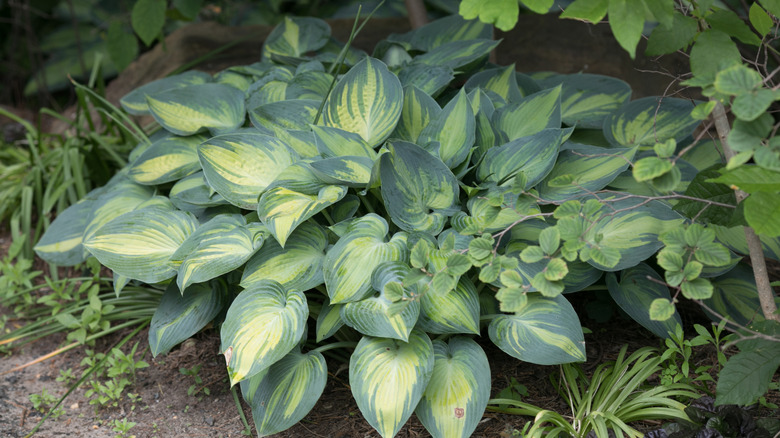
When gardeners mull over landscaping solutions for shady areas, they almost always default to hostas. And why wouldn't they? These shade-loving perennials, with their array of colors, forms, and textures, add a bold lift to the darkest corners of the garden. Plus, if they produce nectar-rich, tubular flowers colored purple or white, or with a strong, fragrant profile, they also lure in hummingbirds. However, if you aren't having much luck with the jeweled birds and feel your shaded garden could use more color, consider companion planting hostas with coral bells or alumroot (Heuchera spp.). Although mostly grown for their striking leaves, coral bells sprout thin stems in the summer, topped with bell-shaped blooms. Brightly colored, they feature colors that encourage more hummingbirds to visit, such as pink and red.
The best part about this planting combination is that coral bells require similar cultural conditions, thus easily fitting in hosta beds. Barring a few variations across cultivars, both plants can handle the shade and thrive in morning sun, where they receive about four hours of direct sun exposure. Hardiness ranges, running from USDA Hardiness Zones 3 to 9, typically overlap, too, as do their requirements for organically rich, well-draining soils, though they can adjust to less-than-amenable conditions. Both are low-maintenance and offer ornate interest throughout the year until frost kills the leaves. However, be prepared to divide heucheras every three years, as they tend to become woody at the center.
How to pair hostas and coral bells for hummingbirds
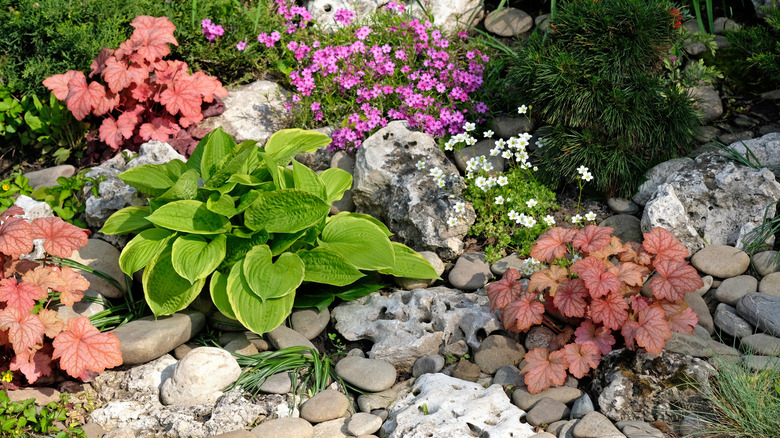
There are several ways you can combine hostas and coral bells to start a hummingbird garden. For a start, you may seek out a shaded patch in a mixed border or a woodlot where both plants thrive. According to your design and layout preferences, intersperse a few colorful coral bells between a grouped mass of about five solid or green-leaved hostas, bringing in a splash of color. You may also take a more traditional approach. Unless they're blooming, coral bells form a neat, compact mound that stays at or under 20 inches. Compared to them, large and giant hosta varieties grow up to 28 inches. So, by placing heucheras in the front and taller hostas in the back, you can create a layered effect. Alternatively, you can team heucheras with smaller hostas to define borders, edges, and walkways.
Even if you lack a typical garden, you can still draw in hummingbirds by growing hostas and coral bells together in pots. Just be sure to water more often because soil dries out faster in containers. Consider creating a themed-color arrangement. For instance, gold-variegated hostas serve as a gorgeous foil for mahogany-leaved coral bells, while blue hostas weave a cool theme with silver-leaved or pink pastel-hued heucheras. For a sure-shot hummer show, utilize native coral bell species or nativars, such as sandia coral bells (Heuchera pulchella), prairie alumroot (Heuchera richardsonii), Heuchera sanguinea, and Heuchera 'Lillian's Pink.' Vibrantly-flowered hybrids like Primo 'Wild Rose' and Dolce 'Spearmint' also make valuable hosta companions.