

What To Do If You Notice A Strange White Powdery Substance On Your Grass
When your goal is to have a healthy, organic lawn, it can be frustrating to suddenly find a strange white powder on your grass. If it isn't late-season snow or some gravel dust kicked up by nearby construction, you may be facing a lawn fungus. While a number of different fungi can pop up in lawns from time to time, the white powdery substance on your grass is most likely powdery mildew. It's a relatively common fungus in turf grass lawns that's easy to identify.
To be sure that you're dealing with powdery mildew, take a closer look at the white patches on your lawn. Up close, powdery mildew looks like small bubbles or boils of fine white dust on your leaves. The dust is actually the spores of the fungus, which will eventually help it spread further. Unlike some fungi variants, which can spread into the roots of your lawn, powdery mildew sits on the leaves. While it looks unpleasant, it doesn't usually cause major harm to your grass.
Since the harm is primarily aesthetic, you don't technically need to do anything. However, you may not want to ignore it, as the appearance of powdery mildew may be a signal that something is wrong. The fungus itself may not cause serious damage, but the root cause can weaken your grass. Powdery mildew thrives in cool, humid weather, and it's commonly found in areas with poor air circulation, overly shady conditions, and excess nitrogen. You can't control the weather, but you may want to check the airflow and nitrogen content in your lawn. Having low amounts of the former and too much of the latter can leave your lawn vulnerable to other pests and diseases. Likewise, sun-loving grass will struggle to thrive in a heavily shaded area.
How to treat powdery mildew on your grass
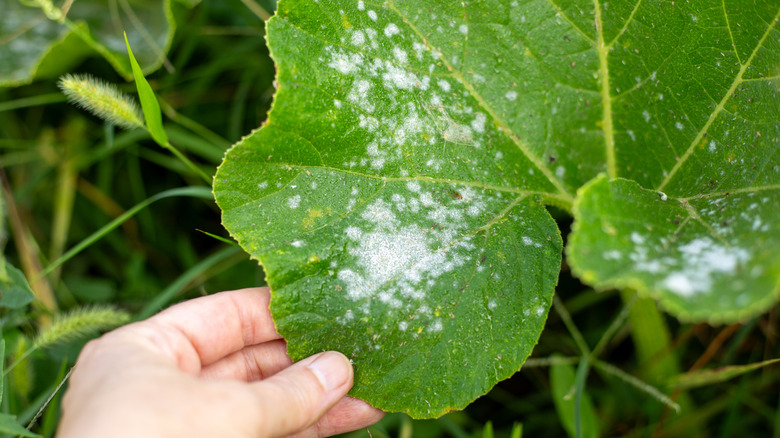
Fungicides aren't usually necessary for powdery mildew (except for extreme infections), but they can be used if the sight of this fungus is just too upsetting for you. Demethylation Inhibitors, also known as DMI fungicides, are generally considered to be among the most effective to use on powdery mildew — although some mildew patches may be resistant. Make sure to follow the instructions on your fungicide carefully. If you're trying to keep your lawn care organic, you can also try home remedies such as using vinegar to kill powdery mildew, though not everyone agrees over how effective they are.
Changing the conditions around your grass is typically a better treatment, as it reduces the risk of future infections and keeps the grass safer from all sorts of diseases, fungi, and pests. Start by checking the nitrogen content of the fertilizer you use and rereading the instructions. The general recommendation for lawn fertilizer ratios is 3:0:2 or 4:0:2, with the first number being the nitrogen content. If your fertilizer has a higher amount of nitrogen, or if you haven't been paying attention to the instructions, you could be overfertilizing your lawn without realizing it.
Improving the air flow through your yard and reducing the amount of shade is also helpful. Aerating your lawn can improve the air circulation through its roots and stems, and getting rid of shade will help grass varieties that aren't suited to it. Consider pruning any trees, shrubs, or other overhanging plants, or reseed the area with a type of shade-resistant grass. You could even swap it entirely for a flowering ground cover that tolerates shade.