

We Put Peanut Butter On Stubborn Glass Jar Stickers So You Don't Have To
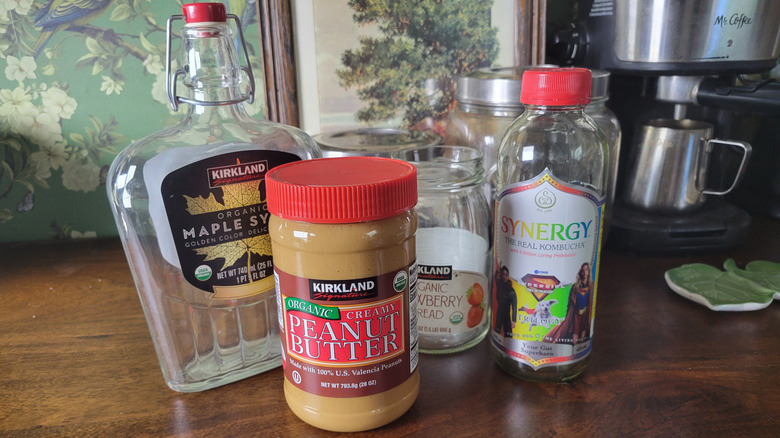
I'd read somewhere that peanut butter was helpful in removing jar labels, but to be honest, I don't usually bother with it. I stubbornly hoard metal containers of any sort — Altoids tins, Wonder Belly antacid cylinders, the boxes some tools come in — but as far as I'm concerned, any glass that isn't compatible with mason jar lids can go straight in the recycling bin. The sizes are irregular, the lids are often ill-fitting, and they multiply like rumors of war. But my wife has recently started reusing flip-top glass bottles for tinctures, and will eventually for making kombucha as well. She uses orange oil, and I naturally wondered if peanut butter was better.
I retrieved a few jars from the recycle/reuse bin, and I noticed when collecting the jars that something had changed since I last paid attention to jar labels, sometime between 20 years ago and never. Specifically, lots of labels seem to be made of plastic now — clear stickers that make the printing look as if it were applied directly to the glass. They're actually made of various substances with "poly" in their names – biaxially oriented polypropylene (BAPP), polyethylene (PE), polyester (PET), and vinyl (polyvinyl chloride). So, I added a couple of jars with plastic labels to the mix.
Next, I inspected our peanut butter stores. We usually have Kirkland Signature Organic Peanut Butter around ($11.69 for two 28-ounce jars, or $46.76 for eight jars, if you're my family). I grabbed a scraper from my toolbox and started smearing peanut butter on jars and bottles. My kids found this more interesting than I did.
Why peanut butter might help with removing labels
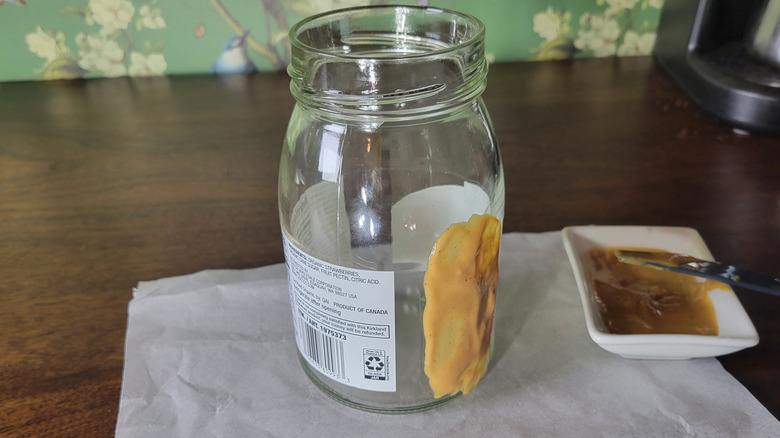
Organic peanut butter (or, I suppose, any non-emulsified peanut butter) will tend to separate into solids and oil, and while I suspect it's the oil that does the work of sticker removal, I went ahead and stirred up the peanut butter, for two reasons. First, if oil is what you want to use, you can easily remove stickers from glass using kitchen essentials like olive oil or, if you're my wife, orange oil, without upsetting the solids/oil balance of your peanut butter.
My second reason for stirring the peanut butter has to do with time and brake cleaner. If I were removing labels for any purpose not related to food, I'd probably just spray brake cleaner on it and scrape the label (and just about anything else) cleanly off the glass. (It's a habit I'm trying to break, and you shouldn't do it because a study warns to stop using cleaning products containing perchloroethylene, which is quite dangerous to your health.) Using brake cleaner involves a time component in that you can't leave it too long, because it evaporates quickly. Peanut butter seems to also have a time component in that you shouldn't try to remove it too soon after applying. I figured that peanut butter acts as a sort of sticker-removing poultice, prolonging contact between the oil and the labels' adhesives in much the same way you can easily remove stickers from glass with shortening. I let half of each label "soak" in peanut butter for 20 to 30 minutes, and left the other half un-soaked for the sake of comparison.
It won't go through plastic, and won't come off anything
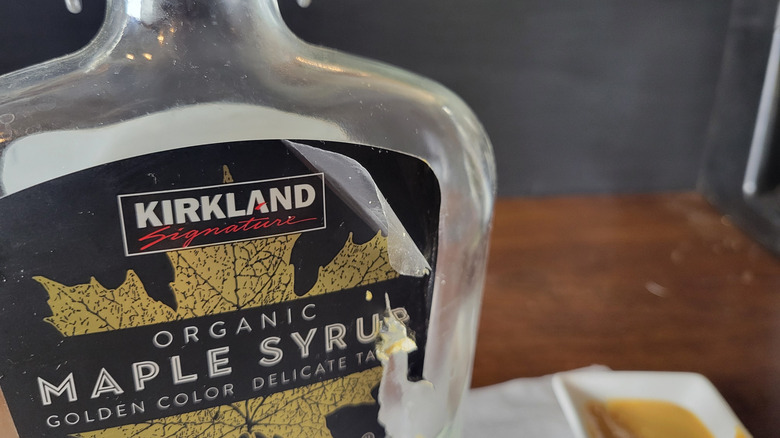
It didn't go well. That is, when the peanut butter worked, it worked like a charm. And when it didn't work, it had almost no effect at all. I suspected this would happen because of the different adhesives used for jar labels (depending on the shapes of the jars, their exposure to temperature extremes or moisture, etc.). But the problem turned out to be the thing I just happened to notice when selecting jars for the experiment: plastic labels. And there are more of them than I first thought. Basically, every jar I selected had a label with some amount of polywhatever on or in it. The clear ones were easy to spot. But even the paper labels were coated with a layer of plastic, and some labels that I thought were paper turned out to be plastic (or a combination of plastic and foil, as with the Synergy kombucha labels).
Also, there were challenges with cleaning up. Easy label removal that's followed by difficult peanut butter removal is a Pyrrhic victory. I don't know if my challenges washing up had to do with mixing the adhesives into the peanut butter, or if hand-washing peanut buttery things is just more annoying that I would have guessed. In any event, my advice would be to try the peanut butter for sticker and label removal, but only on things you can put in the dishwasher. How your dishwasher will handle a lot of glue in a peanut butter solvent is between you and your dishwasher.
It's probably not worth the trouble
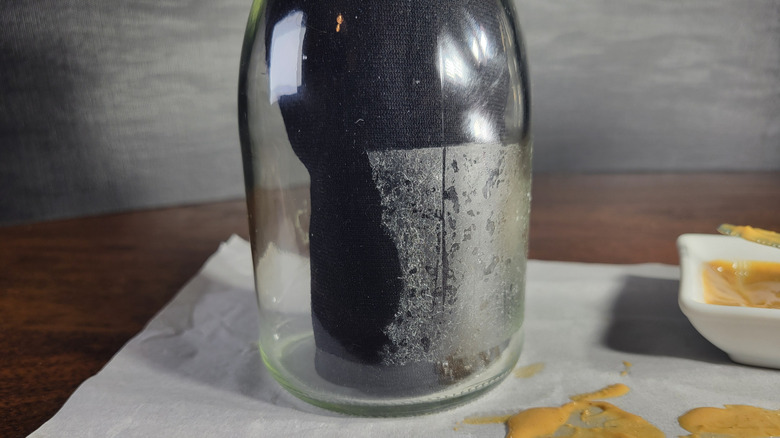
Here's the bottom line: Peanut butter is great for removing paper labels. If your labels are plastic or your paper labels are coated with a film of plastic, as was the case with our Kirkland maple syrup, the peanut butter doesn't seem to be able to penetrate it and dissolve the adhesive below. If you first peel off the plastic coating, the peanut butter works well to remove the paper and adhesive, but I'm not sure that's saving any time or effort.
But get this: Peanut butter appears to be extremely effective as a solvent for most label adhesives. It easily softened and allowed me to scrape the adhesive off every jar and bottle I tried, regardless of label substrate. When I peeled the clear plastic label off a strawberry preserves jar, the adhesive residue left behind would barely budge when hit with a metal scraper. After a few minutes under peanut butter, I could wipe the adhesive off with a paper towel.
Based on my tests, I suspect you're going to struggle often enough to make this hack less than useful, and even when you don't struggle, you could get most of the benefits by using another oil you have handy. There are probably times when the poultice-like ability of the peanut butter to hold the oil in place will come in handy — I just can't think of any offhand. You'll probably find more to enjoy in mixing the peanut butter with what was inside of some of the jars: strawberry preserves, even maple syrup (probably not kombucha).