

Skip Sliding Shelves And Lazy Susans: A Smarter Way To Organize Tall Cabinets
We may receive a commission on purchases made from links.
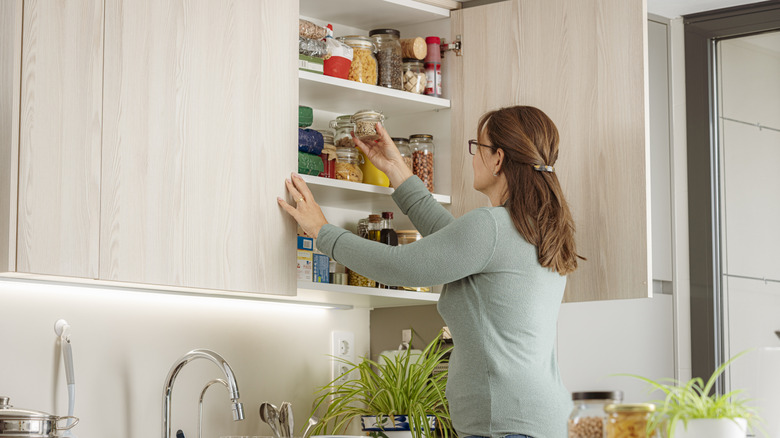
Empty cabinets have so much potential. Yet, little by little, a space that once seemed vast and accommodating can become increasingly difficult to maneuver, as new cookware, toiletries, or tools are placed inside. Whether you're searching for extra kitchen storage ideas, more space in the bathroom, or an added helper in the garage, you'll need a clever system to keep everything in place. While sliding shelves and Lazy Susans are crowd-pleasers, particularly for deep areas, installing a pull-down shelf on a tall cabinet could be the perfect way to optimize overlooked vertical space.
There's a good chance you're not utilizing tall cabinetry to the fullest due to accessibility issues. Perhaps you're not keen on balancing on a step stool while reaching for heavy items from above. Whatever the case might be, a pull-down shelf, which usually uses gas springs or tension mechanisms, only requires a soft tug to get the unit down to eye level, and you only need to give it a soft nudge to raise it back to where it was installed. It's a simple storage hack that can be used either inside cabinets or on their exteriors, if you're looking for even more ways to snag some extra space. Prices range from roughly $40 for smaller versions, such as the types built for storing spices. Larger pieces — those that are intended for kitchenware, like the Slideep Pull-Out Shelf and the Rev-A-Shelf Pull-Down Shelf Organizer – can clock in at anywhere from $300 to over $600.
How to install a pull-down shelf to maximize cabinet storage
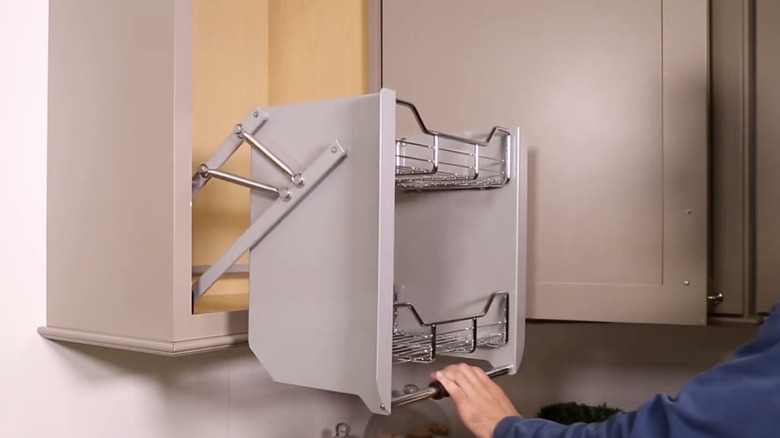
If those rogue container lids and random dishes can't be tamed, it's time to maximize every inch of your cabinet space with a pull-down shelf. Start by measuring the height, width, and depth of the area you want to utilize. Keep in mind that, if you're placing the unit inside the cabinets, you'll want to have a little breathing room to allow you to close the door with ease. Place the brackets of the unit within your cabinets and mark the necessary spots for the hardware with a pen. Most units will include the necessary screws needed to mount the unit.
When you drill the mounting holes, make sure you're not cutting through the cabinet's thickness. Install the brackets, then use a wrench to secure everything in place with the nuts and bolts provided. From there, pre-drill the appropriate pilot holes. Make sure all support systems are level before installing the shelving unit itself. Once you do, use a screwdriver to secure it in place and do a test run before adding your dishes and accessories, keeping the shelf's capacity in mind. When all is said and done, you'll forget what clutter even looked like!