

The Small Tree With Lavender Blooms That Fills Yards With Birds & Butterflies

Flowering trees are a wonderful way to attract birds and butterflies to your garden, but many yards are simply not large enough for a full-sized tree. Enter the dwarf (or semi-dwarf) crape myrtle (Lagerstroemia), a type of flowering tree with beautiful, crepe paper blossoms that bloom profusely in shades of white, lavender, and pink. The common crape myrtle is a decent-sized tree and can grow up to 30 feet in height — far too large for the average garden. Fortunately, there are plenty of dwarf and semi-dwarf varieties that reach a much more modest 1 to 12 feet in height. The semi-dwarf cultivar 'Zuni' features beautiful lavender flowers and attractive brown-gray bark.
This lavender crape myrtle is a fast-growing privacy tree that adds color to even the smallest of yards. Its bright flowers and sweet fragrance attract a variety of pollinators, including bees and butterflies. These trees bloom in the summer, after many other flowers have faded, meaning they offer a valuable source of pollen later in the growing season when food is scarce. In the winter, the seeds of crape myrtles attract many species of birds looking for food. Goldfinches, cardinals, and dark-eyed juncos are just a few of the species that enjoy feasting on winter crape myrtle seeds. Keep in mind that crape myrtles do not provide quite as much value to wildlife as some other flowering trees do — particularly when compared to native species. But, although crape myrtle isn't a significant source of nectar, it is still attractive to pollinators — especially because it continues to bloom in a season when there are fewer flowers to pick from.
How to grow 'Zuni' crape myrtle
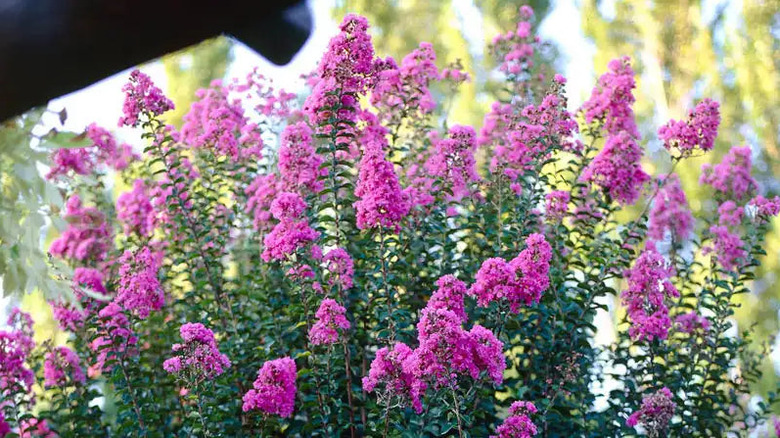
'Zuni' prefers full sun and moist, well-drained soil. While crape myrtles generally prefer warm climates and hot summers, they can also tolerate cold well and are winter-hardy in USDA Hardiness Zones 6 to 9. 'Zuni' is a semi-dwarf variety and can grow from 4 to 15 feet tall. Just how long does it take a crape myrtle to grow to that height? Considered medium- to fast-growing trees, crape myrtles will put on more than 24 inches of height per year.
The best times to plant crape myrtle are fall and early spring. If your soil has a lot of clay, mix in pea gravel or pine bark when planting to improve drainage. Though drought-tolerant once established, your new crape myrtle will need a lot of water during its first season — around two waterings per week if there is no rain. The prime time to prune your crape myrtle tree is late winter (February is best), but early spring also works if you miss that window.
For the smallest crape myrtle options, dwarf varieties, rather than a semi-dwarf like 'Zuni', are the best choice. Coming in at under 4 feet, these plants are sometimes more shrub than tree. If 'Zuni's' lavender colored blossoms aren't quite your style (or perhaps you want to collect even more crape myrtles in a range of colors), there are plenty of other cultivars that come in a rainbow of shades. For a touch of pink, the 5-foot 'Pokomoke' is a great choice. If you want red, the 4-foot 'Tightwad Red' holds true to its namesake with its deep scarlet blooms.