

Not Paint, Not Stain: The Overlooked Way To Give Dated Cabinets A Stylish Refresh
We may receive a commission on purchases made from links.
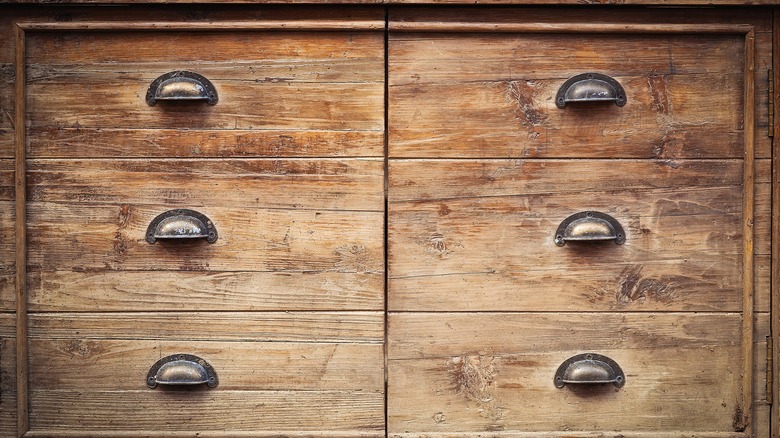
The look of old wood adds a classic touch to any piece of furniture, and some people go to great lengths to achieve it on their cabinets. The technique of making new wood look antique is called distressing, and it may involve scraping the wood with a wire brush, whipping it with chains, or pounding it with a hammer. After beating up the wood, application of a stain or paint highlights the damage. All in all, it's a lot of work. There's an easier distressing technique that produces great results almost instantly, and that's to burn the wood with a torch.
This is something you can only do to bare wood. If you were to attack finished wood with a torch, the finish would melt and the results would be uneven and downright messy. So, if you're going to update an old cabinet, the first step is to strip it, but that's no biggie. It's pretty much a prerequisite for any quality furniture refinishing job. On the other hand, if you have a new, unfinished cabinet, torching is a great way to make the wood look older, whether or not you stain and finish it.
This technique doesn't call for expensive equipment; something like a Utility Torch Kit will do the job, as long as it has an adjustable flame. You also need to ensure the cabinet is sitting on a non-flammable surface and, if you're working outside, no winds are blowing. Keep in mind that this technique is a relatively straightforward DIY when used on smaller projects; however, larger, labour-intensive projects should be done by a professional due to potential safety hazards.
An ancient Japanese wood preservation technique
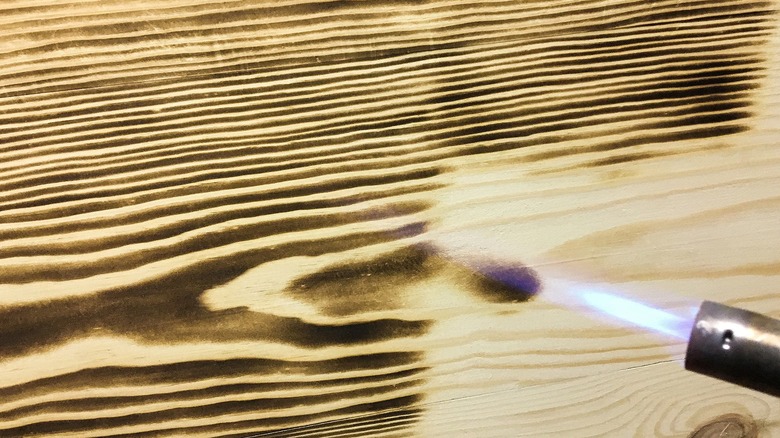
Torching wood isn't a recent technique; people in Japan have been using it since the 1700s. They call the technique Yakisugi or Shou Sugi Ban, which both mean "charred cedar." Cedar is the most common wood species in Japan, but the torching technique works on other lumber options, although the results will differ depending on the hardness of the wood and the closeness of the grain.
The technique itself is very simple and, as a bonus, doesn't require pre-sanding, because the flame naturally smooths the wood. You simply pass the torch over the surface of the wood, which will naturally darken because of the heat. You can regulate the darkness by the speed at which you move the torch, by how close you hold the torch to the wood, and by adjusting the size of the flame. A smaller flame is hotter and generally results in darker wood.
The Japanese used torching as a wood-preservation technique, and what that means for the modern Western craftsperson is that a protective finish is optional. There's no reason you can't apply one, or even stain the wood if you like, but you don't have to. A finish might make sense for kitchen cabinets, though, because it helps the wood shed oils and greases that fly around when you're cooking. If you go for a finish, sand only lightly, or skip sanding altogether, to avoid messing up the charred wood effect.