

Finally, A Garden Hose Storage DIY That Actually Looks Good In Your Yard
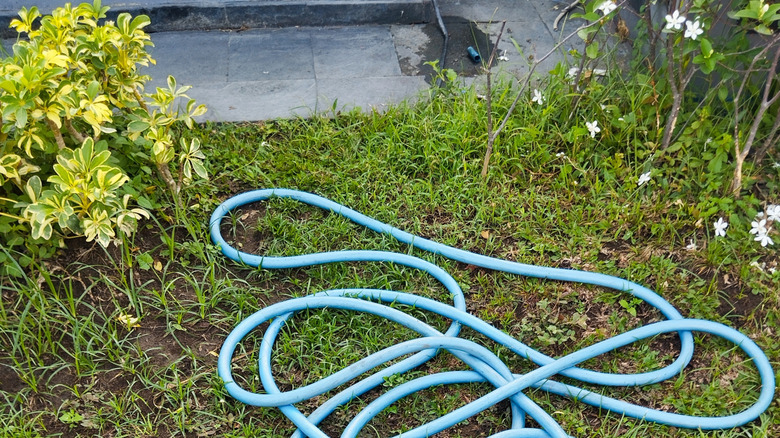
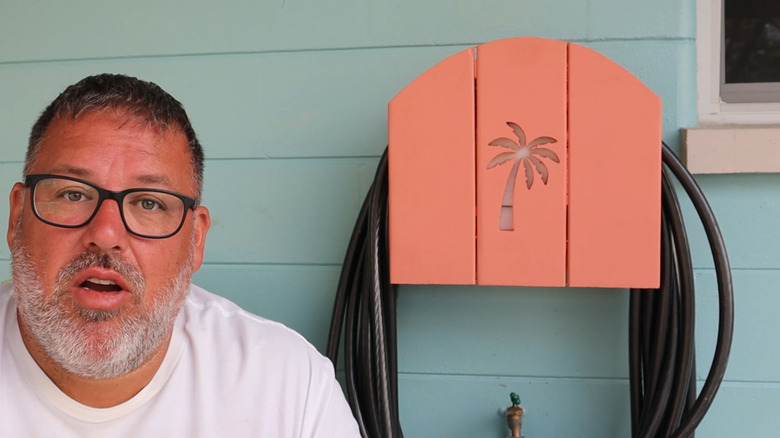
When YouTuber @StoneAndTimberShopClass set out to design and make a garden hose hanger for his house, he pulled it off in a way online woodworkers can't always manage: His project is mostly easy, strong, and attractive. This hose hanger looks like nothing so much as the back of an Adirondack chair, offering your hardworking hose a moment's rest from summer's duties.
We've seen some very cool hacks for managing garden hose and cord clutter, but they're rarely this great-looking. One also occasionally reads DIY stories about how to reuse an old hose reel, and you always know one thing for sure: You won't be reusing it as a hose reel. This is because the things seem doomed to fail, sometimes spectacularly, not too long after their return eligibility expires. Sometimes this is the result of over-engineering or under-engineering, but the solution to both is often simplicity. And this project has simplicity, along with beauty and strength.
Somewhere along the way, he decided to add the complexity of a decorative cutout, and into his somewhat charming mix of old-school tools, including a corded frill and a jigsaw, the creator threw a CNC router, wholly optional, and it's almost a welcome distraction from a project built from a single 12-foot 2-by-6-inch board. The core of the hose hanger is a box with no top or bottom, which will support the hose. The front and back of this core are arched at the top, but @StoneAndTimberShopClass ultimately decided that the arc isn't necessary) ... just one of several ways this project actually got simpler as the creator built it.
Building the hose hanger
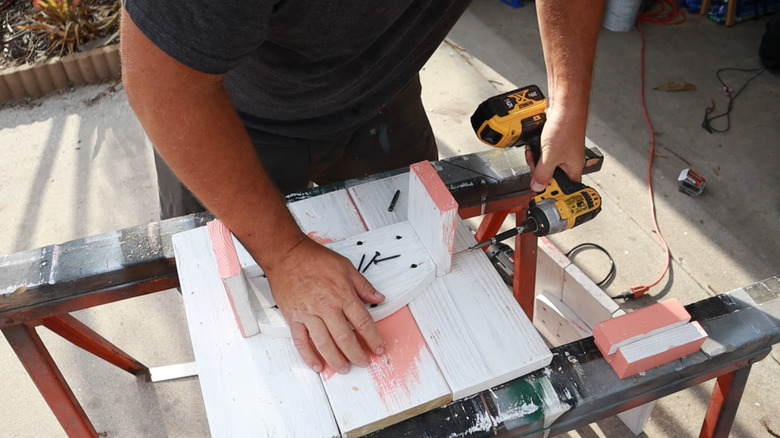
Even at the outset, this is a beginning woodworker project, except for using a CNC for the decorative palm tree cutout. And because @StoneAndTimberShopClass talks his viewers through his challenges, it's a great way to learn how to think about some projects. He begins by breaking down the board into the pieces he needs. Building the core box mentioned above, he drills and countersinks pilot holes for it, since the screws that will hold it together are inevitably near the boards' edges, and pre-drilling will prevent splitting.
The core box is mounted to the back of the hanger, which is made of three vertical boards, just as the front is. But in the center of the front is a decorative cutout of a palm tree. The back will mount to a house, and the front keeps the hose on the hanger. The core box is more or less centered vertically on the front and back. This works if you intend to wind your hose tightly enough so it's not visible from the street. Otherwise, it might make more sense to locate the core near the bottom so the hanger has a larger capacity.
One benefit of centering both the palm tree cutout and the core box is that the box is painted white, which shows through and helps define the cutout. Once the entire hose hanger is assembled, he removes its front and attaches the back to the wall above a hose bibb by drilling through his cement fiber siding. He then reattaches the front to complete the project.
Suggestions to make the project easier
Let's look at a few ways you could make this project easier or better suited to your gear. Not everyone, for example, has a home CNC machine for cutting out decorative elements in their woodworking projects ... though we've seen a compelling case for woodworkers to embrace using CNC routers in their projects. Since the cut is straight through, you could also do it with another type of laser cutter. And, if you're so outfitted, you could even cut out your decoration on a vinyl cutter. On the other hand, if you do have a CNC machine, why not save some time by cutting out the arc on the hanger's front? @StoneAndTimberShopClass's way might be faster and easier, but where's the fun in that?
One thing that becomes obvious during the CNC sequence is that the wood he's using is visibly wet, which doesn't bode well for the longevity of his paint job. Painting pressure-treated wood is often a complicated affair. It often has a high moisture content that interferes with adhesion, and even if the paint adheres, you will likely experience paint flaking due to the moisture trapped beneath it. Use dry wood when you can. Untreated, dry wood finished with a protective sealant is preferable to attempting to paint wet wood. This is what the creator found, and as a result, his paint was "peeling off in sheets." He eventually gets a Rust-Oleum spray paint with primer to stick, but it might not have lasted long. With dry wood, you'll be on better footing.