

Ditch Concrete: There's A Cheaper, More Eco-Friendly Alternative For Your Patio
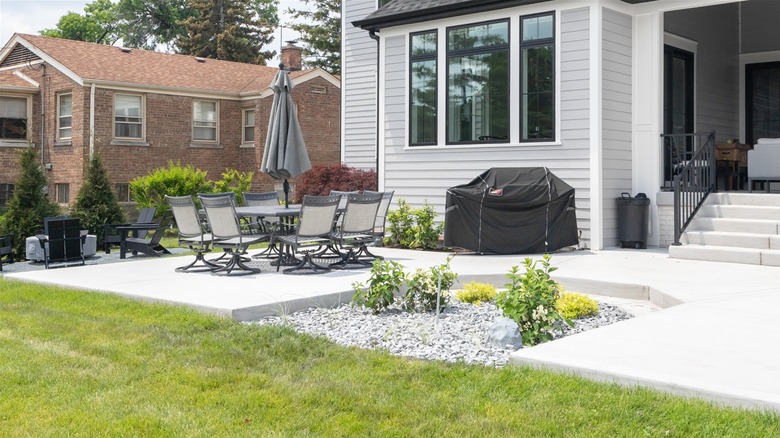
Planning a new patio in your yard? You may have considered pouring a concrete slab or installing concrete pavers. If you're environmentally conscious, you may have even thought about natural stone, which is a gorgeous, more eco-friendly option than concrete — albeit significantly more expensive. What if you're on a budget and you want to lower your carbon footprint? Here's an attractive alternative that has been popular in Europe for three-quarters of a century: rubber pavers.
Rubber pavers are eco-friendly because they are made from old car tires, helping to solve the problem of what to do with the 280 million waste tires Americans generate every year. Beyond that, rubber pavers have many qualities that make a great patio. They look like concrete, but they have more give and are easier to walk on. Plus, they can last 20 years or more.
Rubber paves also have a textured slip-resistant surface that makes them safer than concrete for the elderly and disabled. And because they're made of flexible rubber, they are less likely to chip or crack in changing weather conditions. You can find them in interlocking shapes that form a continuous surface, making them far less likely to develop gaps for weeds to grow through. Bricks, on the other hand, need treatments like homemade mixtures to stop weeds. Finally, because rubber pavers are lighter and easier to handle than concrete pavers, the job of replacing one, should the need arise, is easier.
Tips for installing rubber pavers
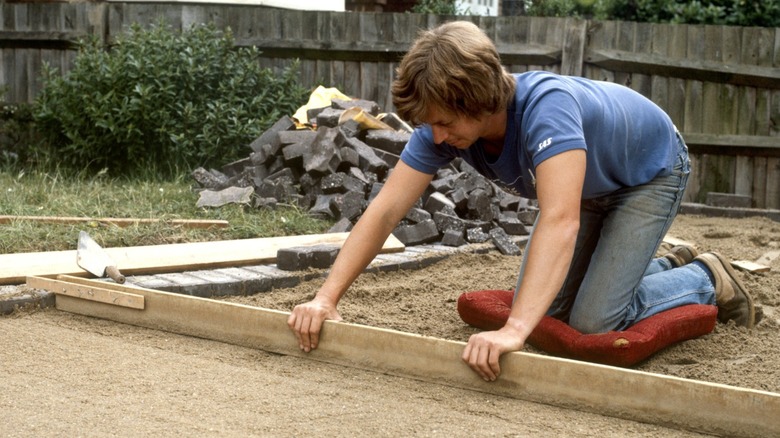
When you choose to install rubber pavers, you don't need to lay rebar or truck in concrete, and you can do the job in cold or damp conditions that would be unsuitable for a pour. Rubber pavers are even easier to install than bricks or concrete pavers, which means you can set them up yourself — though contractors likely won't be as expensive as they are with concrete jobs. It's possible to lay rubber pavers directly over an exiting concrete slab, but if you're building a brand new patio, some prep work will be involved.
The first step is to choose your pavers, and you have a lot of choice in terms of color and shape. Some pavers are square or rectangular and are designed to be stuck together with adhesive, but pavers with interlocking shapes don't need that addition. When the pavers are delivered, be sure to cover them. The color fades somewhat in the sun, and that's fine if the whole patio fades uniformly, but not so great if some pavers sitting on a pallet fade while others don't.
After planning the patio layout, you need to excavate to a depth of somewhere between 9 or 12 inches and drop in a 4- or 6-inch layer of crushed gravel. Then, add a layer of compacted stone that's 3 or 4 inches, and provide 1 or 2 inches of sand as bedding. After leveling the sand, install the pavers by tapping them together with a rubber mallet, build a border, and you're done.