

What To Do If You Find A Bald-Faced Hornet Nest In Your Yard
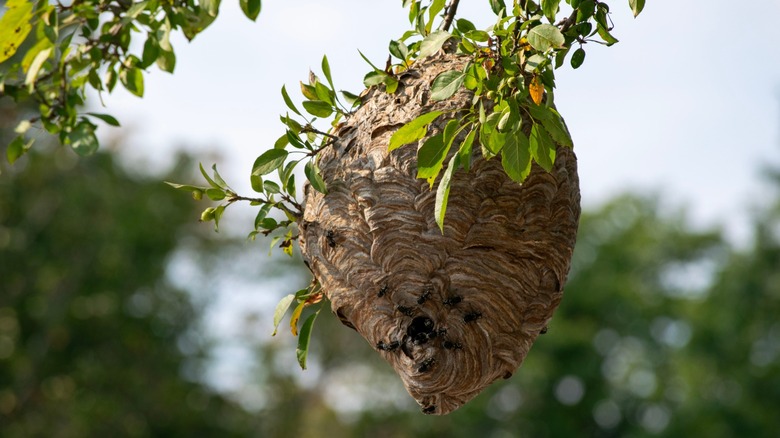
Bald-faced hornets aren't actually hornets, but that doesn't make much difference if one happens to sting you. These large, black insects, with cream-colored markings on their faces, legs, and thoraxes, are actually related to yellowjackets, which are wasps. Like yellowjackets (also known as meat bees), they are social insects that build nests in which hundreds reside. Unlike yellowjackets, they build these nests in trees, under eaves, and hanging from rafters inside sheds and garages. If you see a bald-faced hornets' nest in your yard, it isn't a cause for freaking out — but you should definitely stay away from it.
A bald-faced hornets' nest is hard to miss; it can be the size of a basketball. It looks like it should be heavy, but, because it's made from a mixture of wood fibers and saliva, it's actually quite light. Inside the nest are individual cells in which the workers hatch their larvae and nurse them to adulthood. And of course, each nest houses a queen — the only member of the colony able to survive the winter, and the one that established the nest in the first place.As bald-faced hornets are social insects, seeing one is a sure sign that there's a nest somewhere nearby — usually less than 200 yards away. You may be able to find it by tracking the movements of the hornet you see.
Why it's best to leave a bald-faced hornets' nest alone
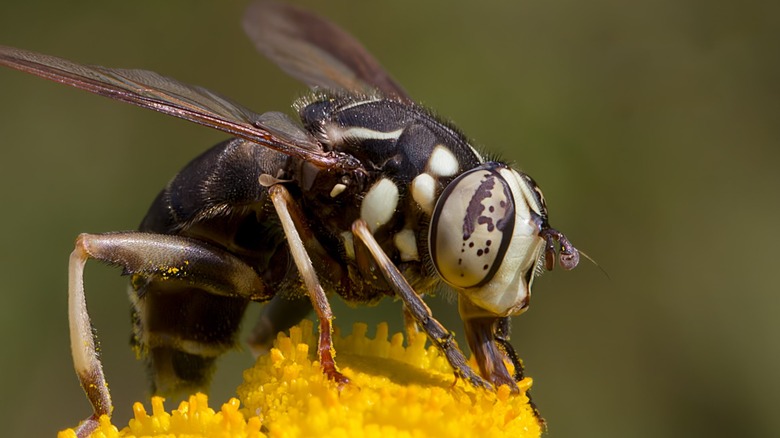
Leaving a bald-faced hornets' nest alone in late summer is a good strategy, because that's when the nest is most active, and the wasps will aggressively defend it if you get too close. Unlike bees, bald-faced hornets can sting repeatedly. The sting is painful, and just one can cause an allergic reaction in sensitive people.
When away from the nest, the insects are not aggressive. In fact, because they're pollinators and act as predators to other insect pests, they are actually beneficial to your local ecosystem, so it may be worth leaving the nest alone. Besides, the nest will die off in the winter, and it won't be reused the following year. It may also be empty already, which means it isn't a threat at all — it could even work as a fake wasps' nest to keep certain species of wasp away.
You can't be as complacent if you find an active nest inside your house or garage, however, in which case you may need to get rid of it. Due to the aggressive nature of these insects, this isn't a DIY job. You should hire a pest control expert, who may use a combination of different sprays to immobilize and kill the insects. Even if you try to safely get rid of a hornets' nest yourself, you could be swarmed if you misfire. Once the nest is empty, you might consider leaving it where it is as a good luck charm, the way old-time mountain dwellers are reported to have done.