

Why There's Simply No Need For Curtains Anymore
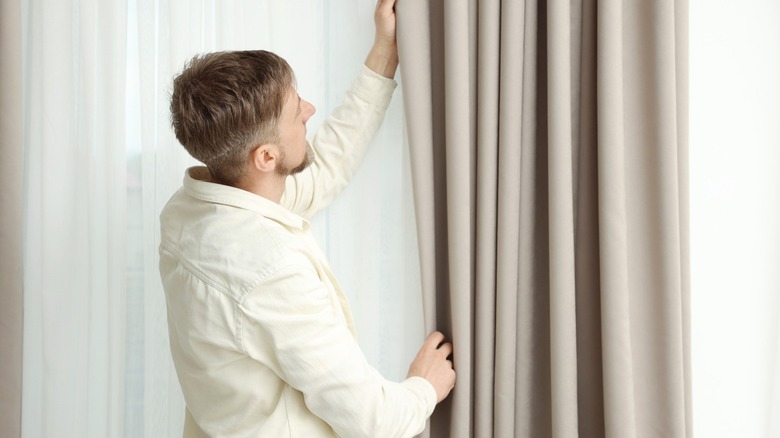
Without a window covering, you're living in a fish bowl, exposed to prying eyes from outside and vulnerable to the glare of direct sunlight. Does that mean you need curtains, though? It depends on your aesthetics, but there are many reasons why blinds are often a better option. They're less cumbersome, easier to clean, and available in styles that fit every type of window. Plus, your kids and pets can't turn blinds into playthings, napkins, or scratching pads the way they might with curtains.
Some people like curtains and drapes because of the plush quality they add to any room, but they take up space, and that can make a room feel smaller. That may be a good thing in a large living room but not so great for a smaller living room or a bedroom. Moreover, like anything in the house, they tend to collect dust. To clean curtains and drapes properly, you usually have to take them down, which is a hassle you'll avoid by forgoing these kinds of window treatments altogether.
Another problem with curtains is that, unless you layer them, they often make it difficult to adjust the amount of natural light entering the room. If they're too heavy and darken the room when they're closed, they can actually have a negative impact on your mood and mental health unless you keep them partially open. Lightweight and semi-transparent curtains, on the other hand, offer limited privacy and ability to control light.
Why blinds can be a better choice than curtains

Blinds aren't the only window treatments that can replace basic curtains, but they have four things going for them. For one, blinds are far easier to adjust. If they have slats, you're able to open and close them part way or all the way with the turn of a rod, and if they aren't slatted, you can raise or lower them just enough to get the light you need. Another advantage is that, unlike curtains, blinds fit inside the window well rather than over it, which makes the room feel more spacious and leaves the sill available for flowers and other decorative items. Thirdly, blinds are easier to manage in some instances. There's typically no need to take them down, and you can often use just a vacuum, a damp cloth, or a Swiffer duster to clean your blinds.
The biggest advantage to choosing blinds over curtains might be cost. According to HomeGuide, off-the-shelf blinds cost between $30 and $200 per window, although the price could jump to $600 for customized blinds and to $1,000 for state-of-the-art motorized ones. Compare that to a cost between $50 and $500 for off-the-shelf curtains and as much as $4,000 for custom-made ones.
Because they're made from fabric, curtains come in a wide spectrum of colors, but blinds now also offer color choices to suit your aesthetic needs. Faux wood blinds come in wood tones, and you can find conventional roller blinds in practically every color in the spectrum. And even if you just really like curtains, you still might want to consider combining them with blinds to add more color and personality to your space and give you better control of natural light.