

The Easy Swap That'll Help Keep Flies Away From Your Porch
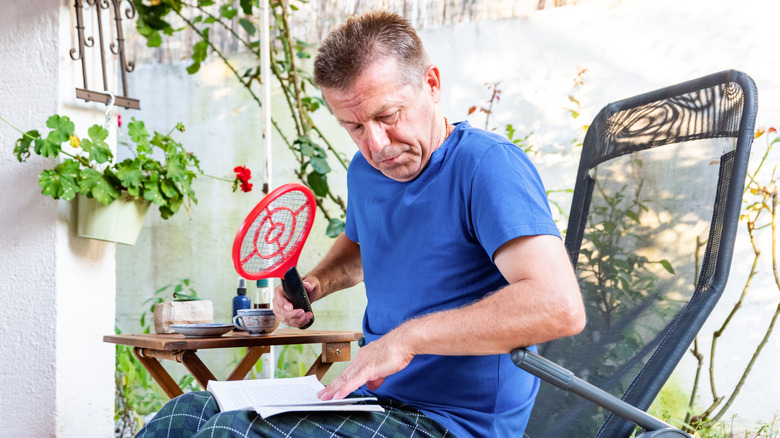
When pleasant weather arrives, your porch is where you'll want to spend plenty of time — but pesky bugs tend to be a problem. Whether you're enjoying sunset from your favorite Adirondack chair or spending time with friends late into the evening, insects are sure to join the party at some point. If flies, in particular, tend to flock to your porch and frustrate you, you might be unknowingly attracting them. So to prevent flies from gathering on your porch and interrupting your time spent outdoors, one simple swap might help. Check your porch lights: Are they shining with cool, blue-leaning light? If so, they may be playing a key role in drawing flies to your porch. Swapping those cool light bulbs for ones that give off warmer, yellower light can help keep flies away.
The color of your porch lights or outdoor lights can have an impact on just how many flies and other insects hang around. Research presented by the American Association for the Advancement of Science has found that warm lighting attracts fewer insects compared to cool lighting — after testing incandescent, halogen, compact fluorescent, and light-emitting diode light bulbs, the warm-hued LED bulbs with yellow to orange light attracted the fewest insects. In fact, warm lighting from basic LED bulbs outperformed even "bug lights" or bulbs specifically marketed to limit insect attraction.
The worst offenders when it came to drawing insects right to the light? Incandescent bulbs that gave off a cool blue light proved the most appealing. So if you're hoping to make your porch less appealing to bugs like flies, a light bulb swap could do the trick.
Swap outdoor light bulbs to make them less appealing for flies
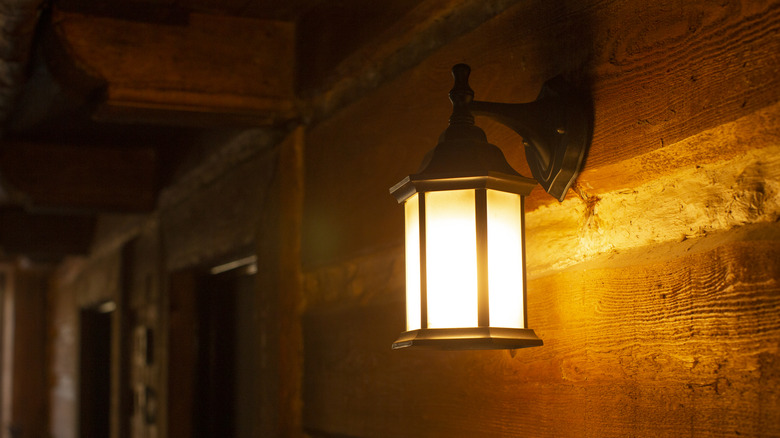
To put this easy fly-limiting swap to work for your porch and other outdoor spaces, start by choosing the right light bulb colors — and that means taking color temperature into consideration. Other key light bulbs terms you need to know include a light bulb's wattage, which tells you how much power it uses, and lumens, which refer to the brightness or amount of light a bulb provides. But color temperature will help you understand what color lighting a bulb delivers, as well as its warmth.
Because insects such as flies are drawn to cool blue light, avoid bulbs that fall into the bright white and daylight color temperatures. Bright white bulbs strike a middle ground between white and blue, with a temperature range of 4,000 to 5,000 Kelvin. Daylight bulbs are similarly cool-toned and emit even bluer light, with a temperature range of 5,000 to 6,000 Kelvin.
Instead, choose soft white or warm white bulbs, both of which lean yellow. Warm white bulbs are softly yellow-white and warm, with a range of 3,000 to 4,000 Kelvin. However, soft white are the yellowest — and likely most fly-repellent — option. Soft white light bulbs fall between 2,700 and 3,000 Kelvin and deliver the warmest yellow lighting. Another easy trick that can help discourage flies is to stop leaving your porch lights on at night, instead turning them off whenever you don't need their illumination. That way, you'll eliminate the wavelengths these lights emit that make them so appealing to flies.