

Rare Vintage Glass Piece Called The 'Holy Grail' Of Valuable Estate Sale Finds

Around 800 years ago, poets began telling tales of knights in search of a sacred chalice known as the Holy Grail. Little did they know (nor could they comprehend) that the mythic term would one day be reclaimed by internet shoppers on a quest for just about any hard-to-find item. Modern holy grails range from this rare '80s lamp found at a thrift store to beauty products that halt aging. For Reddit user Ointmentt, the legendary Holy Grail is a stained glass panel with a bunch of cats on it.
In 2024, Ointmentt posted a picture of a thrifted stained glass piece in the Reddit group r/ThriftStoreCats with the caption, "My holy grail Estate Sale find." Many cat lovers were smitten with the antique too, giving the post more than 19,000 upvotes. "I didn't know what my holy grail find would/should be until I saw this post," one commenter wrote. The item was purchased for $70, widely considered a bargain on the Reddit thread. "$10 a cat is a deal," another user wrote, referencing the panel's seven glass felines.
This estate sale pickup appears to be made by Joan Baker Designs, a now-defunct company founded in 1975. Some Joan Baker products are still sold online today. Small pieces cost as little as $20 on Amazon, while larger, rarer ones are listed on auction sites for several hundred dollars. To at least one Reddit user, however, their Joan Baker piece is priceless.
How to find and identify vintage stained glass
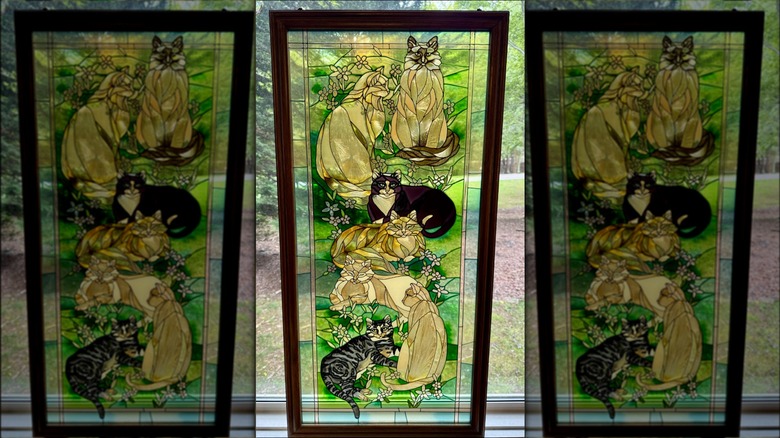
Fortunately, there are many places to find your very own stained glass holy grail. Estate sales are a great source for eclectic, valuable items, as evidenced by the stained glass cat panel. Other in-person options include thrift stores, antique stores, consignment shops, and a Joanna Gaines favorite, flea markets. Online retailers and auction sites offer a variety of stained glass, too, often sortable by price, size, and style. One downside is that it may be difficult to tell exactly how a piece looks and if you'll like it from pictures alone.
As for authenticating and determining the age of stained glass, it can be challenging, but there are a few things to look for. Ideally, the manufacturer is labeled on the piece, sometimes with a monogram or a sticker, which can make it easier to research when it was made. A piece's style may indicate a time period; for example, geometric designs were popular during the Art Deco period, roughly between 1920 and 1940. The glass itself holds some clues, too. Glass streaked with multiple colors could be opalescent glass, which wasn't patented until 1880.
Another distinction between real and faux stained glass are the lead lines. When these are made from tape or paint that don't fully connect, the piece is often faux. But if your only goal is finding stained glass you like, not flipping it for a profit, then its age and authenticity don't matter. Each person's holy grail is unique, and you'll know it when you see it.