

Sharpen Your Dull Scissors With A Tool You Already Own
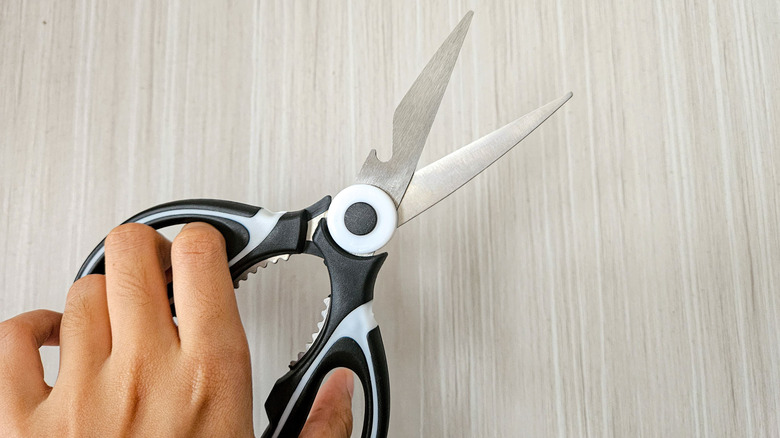
Grabbing your go-to scissors for a quick cutting task can prove pretty frustrating if your sticky scissors need a fix or your once-effective blades have dulled. Over time, even the most durable scissors will need to be sharpened, and the more frequently you reach for your scissors, the faster the blades will start showing wear. Every time your scissor blades touch, they're essentially grinding down their own sharp edges and dulling slowly. If you're struggling to make clean cuts in paper anywhere along the scissors' blades or find yourself exerting a significant amount of effort to cut through different materials, it's likely high time for a sharpening.
But you don't have to break out a whetstone (though you can do that, if you'd like) or take your everyday scissors to a professional; the process can even be easier than sharpening your gardening shears. Odds are you already have a drill bit in your tool kit, and you can sharpen your scissors by running the blades across its surface.
Sharpening your average pair of scissors with nothing but a drill bit is super easy and delivers a sharper cutting edge when you're in a pinch. Your very own tools can come in handy by acting similar to a honing rod, since different types of drill bits are made out of materials like steel and cobalt (and some are even coated with durability-enhancing extras like carbide or titanium, and they're fine to use for sharpening, too). It's that highly durable nature of a drill bit that makes this a suitable choice for restoring sharpness to your scissor blades in a matter of minutes.
How to sharpen scissors with a drill bit
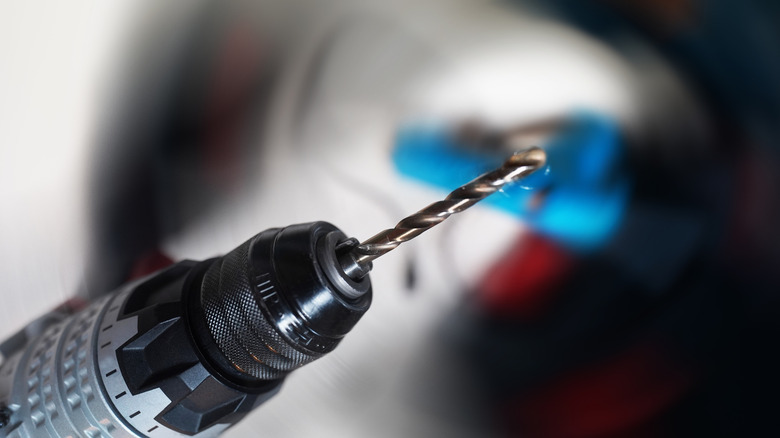
To make your scissors feel sharper and cut more easily and precisely, you'll want to grab a basic drill bit. Opt for one of your larger bits — 5/8-inch or 1/2-inch are good sizes — and line your scissors' blades up at the smooth end (not the ridged end). Pull your scissor blades across the end of the drill bit, dragging them against the metal surface as you mimic a typical cutting action. You can move the scissors quickly and repeat the motion as many times as needed until your blades feel noticeably sharper; you can test them against a sheet of paper as you work. When they cut through paper (or whatever item you were working on while the blades were dull) with ease, your work is done.
This trick also works with another essential tool that you likely have on hand: a simple screwdriver. Like drill bits, screwdrivers are typically made with shafts crafted from metals like steel, alloy steel, or chromium-vanadium alloy that are also similar to honing rods. Using the same cutting and pulling method across the screwdriver's shaft (and not its handle, of course), you can swipe your scissor blades to achieve a sharper cutting surface. Just note you'll want to angle the screwdriver perpendicular to your scissors as you're pulling across it, a slight twist on the drill bit sharpening approach.