

The Valuable Vintage Pottery You'd Be Lucky To Find At A Thrift Store Or Estate Sale

When it comes to thrift stores and estate sales, there are plenty of unexpectedly valuable collectibles out there that you shouldn't overlook. One such treasure is pottery. Whether it's a nice cloisonné and champlevé vase that holds hidden value or a simple teapot you can use at your next gathering, pottery items often hold hidden value, whether it's personal or monetary. However, if there's one type of vintage pottery you'd be beyond lucky to find at a thrift store or estate sale, it's anything by the artist Charles Counts.
Counts, who lived from 1934 to 2000, was a mid-century American potter whose work paired simple shapes with unique markings and engravings. Counts was heavily influenced by the Civil Rights movement, and many of his pieces bear imagery from that period. These included vases, jugs, plates, bowls, and cups.
If you want a frame of reference for the value of a Charles Counts piece, know that you can pay upwards of $200 for one of his plates, and $2,200 for larger pieces like a taller upright vessel. This is why Charles Counts' work is one type of pottery you should never pass up at a thrift store or estate sale — you never know if you're overlooking a hidden treasure.
How to identify a piece of Charles Counts pottery
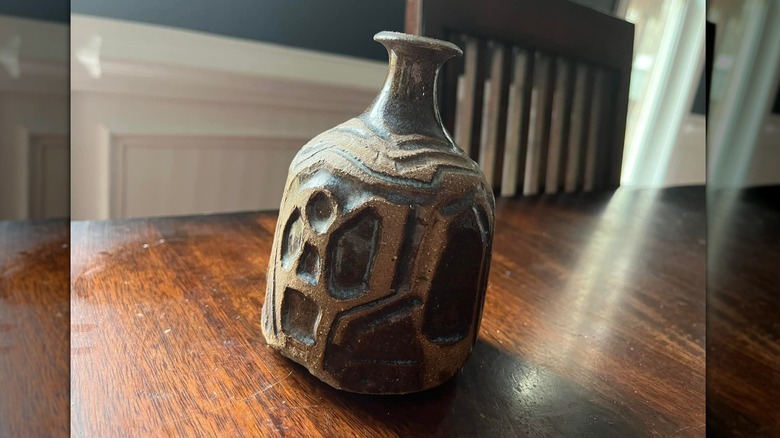
While the deep carvings and natural imagery will be a decent visual cue as to whether or not you've located a Charles Counts piece, the best way to know for sure is to turn the pottery over and look for the maker's mark embossed on the bottom. Counts used a number of different signatures over the decades. His earliest pieces are marked with either "Beaver Ridge" or "Rising Fawn," both names of Southern U.S. locations where Counts created his work.
His other maker's marks included a simple "CC" signature, with one C stacked vertically atop the other. (The "CC," of course, stands for Charles Counts.) Other variations include "Charles Counts Beaver Ridge" and "Charles Counts Rising Fawn." If these signatures are present, the piece is authentic.
It's important to understand, however, that just because you've found a Charles Counts piece doesn't mean it will be valued like the pieces mentioned above. A lot depends on age, rarity, and the quality of the piece. Rare, well-kept items are going to fetch higher prices due to their uniqueness. You can check auction or appraisal houses, or even search eBay for an idea of what your piece might be worth. Even if you find something as simple as one of his beautifully thrown clay plates, consider yourself lucky to have found work by such a unique American artist.