

HGTV's Mike Holmes Reveals Which Kitchen Floors Aren't As Practical As They Seem

The material you choose for your kitchen floors must be carefully considered. It needs to be something that is going to stand up to heavy traffic, food spills, moisture, scratches, and all the other manner of wear and tear that occurs in a room as busy as a kitchen. Owing to its strength and durability, concrete has become a popular option for creating unique and dreamy kitchen floors. However, HGTV's Mike Holmes reveals why these types of floors aren't necessarily as practical as they seem.
While concrete does provide the kind of pseudo-industrial look that many homeowners appreciate, Holmes does not believe it is the correct choice for the majority of home remodels. "It is very heavy [material]. This is because of the minimal depth required to pour a solid concrete floor that won't crack or crumble. Also, keep in mind the joist strength required to support this additional weight," Holmes writes for his Make It Right blog.
The minimal depth standard for foot-traffic concrete surfaces, such as patios, is 4 inches thick. At this depth, the concrete will weigh about 50 pounds per square foot. If you are working with a space that is between 70 and 100 square feet for a galley layout and up to 200 square feet for an open concept plan, you're looking at between 3,500 and 10,000 pounds of concrete sitting on your joists. Unless you're prepared to make the subfloor strong enough to support that weight, don't pour a concrete floor in your kitchen.
When concrete floors work and some alternatives
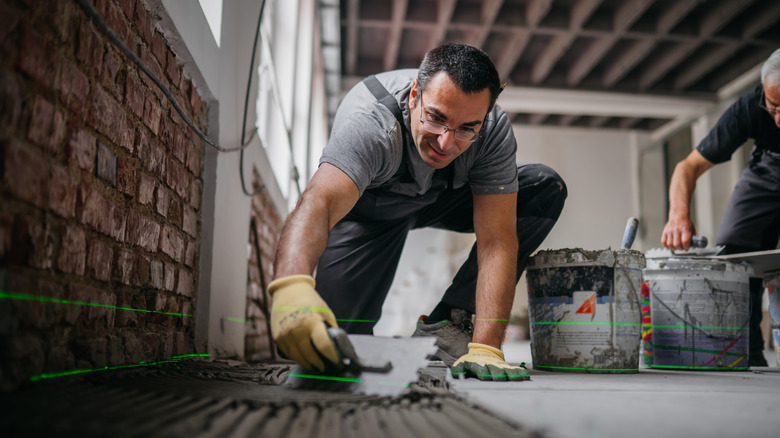
It's not all bad news for concrete floors, however. There is one case in which adding a concrete kitchen floor would be quite practical, and that's when you're building a new home. As Holmes writes in Make It Right, "If you are building a new house, you could make the structure strong enough for concrete. It can be finished with a variety of stains or acid etchings that can make it look more interesting." For example, when utilizing a slab foundation, you can just leave the concrete as it is and provide treatment for it later. A properly sealed and maintained concrete kitchen floor can last around a decade.
However, not everyone is going to be able to build their dream home from scratch. For those who are simply contending with restoration, Holmes has some recommendations. His top pick for kitchen flooring is ceramic or porcelain tile. These materials are prized by Holmes for their long-lasting capabilities, including resistance to scratches, waterproofing, and resistance to wear and tear from foot traffic.
If you absolutely have to have the concrete look, however, self-leveling concrete is an affordable and less weighty option. It can easily attach directly to a properly prepared plywood subfloor and, owing to its lower viscosity, can be applied in a thinner ½-inch layer that will dry in hours, not days. Seal it properly, and you have a concrete-looking kitchen floor without the hassle and stress of a full pour.