

Why There's Simply No Need For Bulky Entertainment Centers Anymore
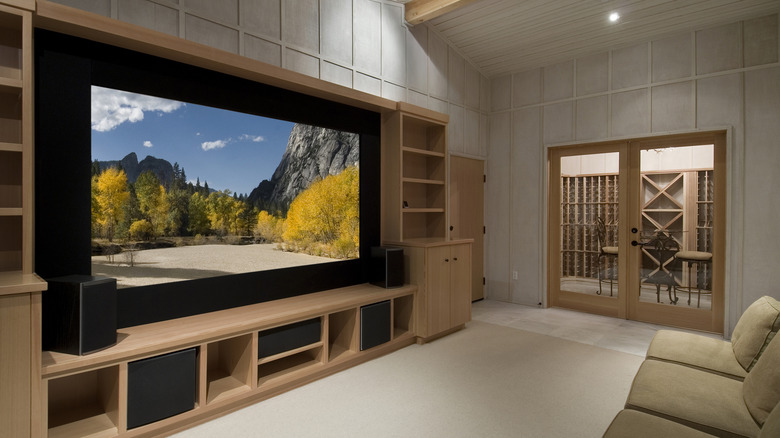
When you picture a classic entertainment center, what do you see? Odds are, it's some combination of a TV, a component stereo system, a DVD player, some media on the shelves or in those slots sized especially for wasting room when you are storing CDs. There's probably a cable box and maybe even a TiVo-style DVR, if you were once fancy like that. If trends hold, the modern entertainment center will contain none of those things. In fact, it will contain almost nothing at all, to be replaced by simple stands; the narrow, often industrial-looking racks used mostly by audiophiles for specialized gear; or nothing at all.
The reasons that media goodness is disappearing are many and varied, but they boil down to two factors: Screens have gotten a lot bigger, while Internet-based services have made everything else vanishingly small. Meanwhile, all the media we stuffed into these devices for decades — the VHS tapes, CDs, DVDs and Blu-Ray, audio cassettes, and laser discs if you want to get ridiculous about it — have almost entirely disappeared.
According to the U.S Energy Information Administration, as of 2020, about 97% of televisions were flat-screen (LED, LCD, and plasma). They have grown in size so dramatically since 2015 that they're most easily wall-mounted and unlikely to fit in any given entertainment center anyway. Any free-standing entertainment center that could accommodate a TV that's 60 inches or larger would also have a lot of other spaces, at least below the TV ... and there's not much left to take up that space these days.
Audio-video hardware and physical media go the way of all flesh
The advent of audio streaming platforms like Spotify have relegated component stereos to the garage (or a thrift store). Spotify alone currently has 713 million active users — approaching three-quarters of a billion people — who come for the streaming service's 100 million tracks, 7 million podcasts, and 350,000 audiobooks. That's rather more than your old entertainment center could hold without some kind of quantum physics intervention. Same with video: Because of on-demand streaming, more than twice as much U.S. TV viewing happens on streaming platforms vs. cable TV subscriptions, which have declined 35% in 15 years, and 12% of U.S. households with internet service have never even had cable or satellite television service, according to Nielsen.
Gaming consoles are hanging around, for now. The only other survivors of the classic entertainment center — conventional cable set-top boxes — are being phased out, replaced with cable-emulation streamers like Xumo, smart TVs, and tiny streaming devices like Roku, Amazon Fire, and Google TV, often little more than an HDMI dongle that attaches to the back of your TV.
As a result, physical media are now mostly useful in DIY projects like making cool birdbaths out of repurposed CDs. Yes, vinyl records have made a bit of a comeback, but those sales only represent around 8% of U.S. music revenue according to the Recording Industry Association of America. Of course, there's still the occasional pull of nostalgia, and '90s thrift store entertainment tech finds will continue thrilling some until it becomes fashionable to revere the 2000s instead. We'd tell you to hang onto your stereos until they're in again, but where would you keep them?
Where have all the entertainment centers gone?
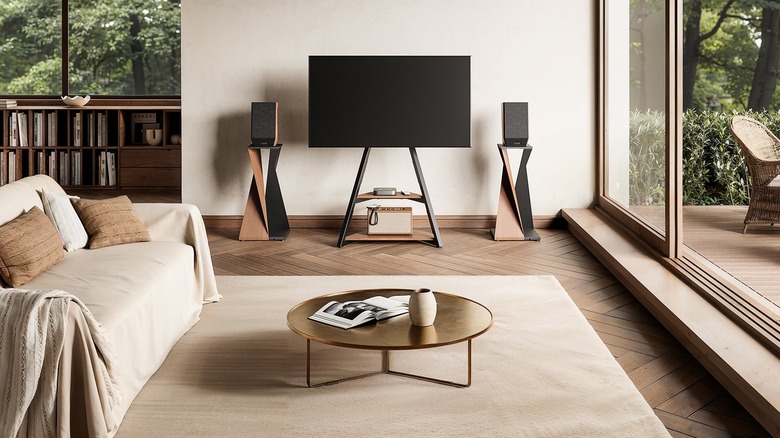
This cloudification of media ultimately means that entertainment centers in general — not just bulky ones — are well along the path to extinction. What hasn't gone is the screen, so the traditional "entertainment center" has become a sort of ornate bezel around huge flat-screen TVs. It doesn't contain entertainment, exactly, but a handful of books and a couple of textured white vases. Of course, there's always the console-table-underneath-the-TV approach and the stick-it-over-the-mantle approach, both of which will accommodate a soundbar.
Fitueyes offers TV stands that are minimalistic and resemble nothing so much as artists' easels, and commonly displayed in ads with abstract paintings on-screen. These have enough shelf space for one or two components ... more than enough for most people. The company also offers its Zen series, plinth-like stands with a design reminiscent of those acoustic slat panels everyone has on their walls these days. The Zen series accommodates a small, optional shelf that are useful for remote controls if nothing else.
The other general approach seems to be wall-mounting the TV in the most inconspicuous spot you can find for a 17-square-foot black rectangle. Mounting it over your fireplace is increasingly discouraged on practical and occasionally philosophical grounds, but never fear: There are plenty of other creative ways to incorporate a TV into a living room.