

The Indoor Plant That Will Thrive In Your Humid, Lower-Light Bathroom
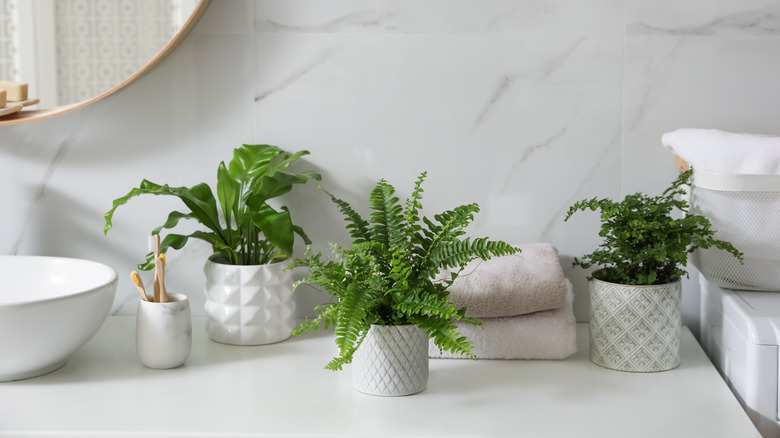
Privacy is necessary in a bathroom, so unless you live in a remote area, it's usually the last room in the house where you'd want oversized windows. However, having smaller windows means less natural light, which can make it difficult for most plants to absorb nutrients from the sun and grow. Thankfully, just because the bathroom isn't suited for every houseplant, that doesn't mean some won't happily grow there. In fact, the bird's nest fern (Asplenium nidus) doesn't just survive in a dim, humid room; it thrives.
The bird's nest fern is often grown as a low-maintenance indoor plant, though it's an epiphyte that grows on trees or rocks in the wild. This type of fern probably isn't what you'd typically picture, as it has wide, bright green, strap-like fronds with wavy margins rather than the delicate, feathery foliage most people associate with ferns. It grows in a funnel-shaped rosette with new fronds that emerge from the center. As they slowly unfurl, it resembles a bird's nest, hence the common name. While it can reach up to 4 to 5 feet tall in nature, it typically grows to about 18 to 24 inches indoors. This is also a human, dog, and cat-safe indoor plant, so you can keep it anywhere in your bathroom without worrying about curious pets or kids getting sick if they sneak a bite.
Why bird's nest fern thrives in a bathroom
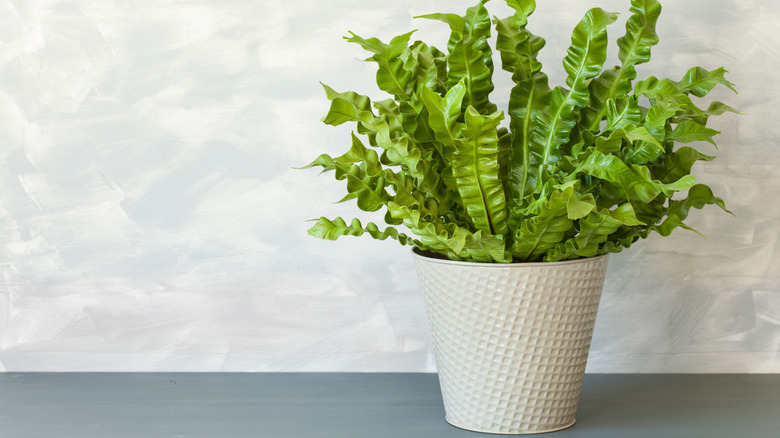
Like most ferns, the bird's nest fern thrives with bright, indirect light or dappled shade, so it grows well in a lower-light bathroom. If the edges of your bird's nest fern turn brown, the large fronds are likely receiving too much direct sunlight. For this reason, it grows best near north or east-facing windows. In south or west-facing bathrooms, you may need to place it a few feet back from the window or use a sheer curtain to filter out some of the sunlight.
In addition to light, bathrooms are also one of the most, if not the most, humid rooms in the house. Native to tropical areas across parts of Southeast Asia, Australia, and New Guinea, this extra humidity closely mimics the bird's nest fern's natural environment. If the winter air becomes too dry, using a humidifier can help maintain the moisture levels until the weather warms back up. Alternatively, you can boost humidity by placing the container on a tray filled with water and pebbles.
The bird's nest fern is relatively low-maintenance and easy to care for. Keep it in rich, well-drained soil and water when the top inch of soil begins to dry out. However, you don't want the soil to be bone dry between waterings. Water near the edge of the pot to prevent water from pooling in the center of the plant or splashing onto the fronds.