

If You See A Tree Painted White, Don't Ignore It! Here's What It Means
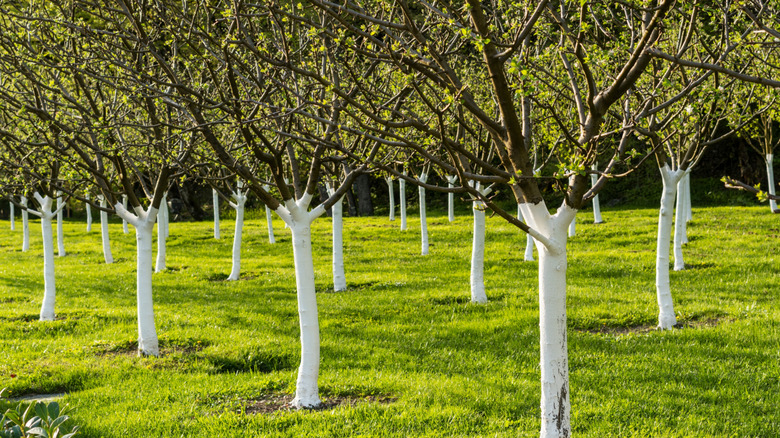
People have long painted on trees to telegraph messages and signals. For instance, purple paint on trees is meant to denote private property and warn against trespassing. Other colors painted on trees represent a number of various meanings ranging from awareness for specific causes to marking boundaries or trees that are to be removed. So, if you see colors painted on trees, it's worth taking notice. However, if you see trees with a portion of their trunk painted white, it has nothing to do with sending a message. There are a variety of reasons for which it's done, but primarily it has to do with sunscald prevention, pest deterrence, and aesthetics.
One of the most common reason for painting the trunks of trees white is to protect trees from sunscald. This issue is especially prevalent in areas where there is a great variance in temperature between the daylight and nighttime periods, such as the desert Southwest. The expanding and contracting caused by the rapid change in temperatures can cause tree bark to split. Painting the trunk white prevents the trees from absorbing so much sun and somewhat moderates the wild temperature fluctuations.
This same rationale is also why paint is often applied to fruit trees throughout the country. Due to their smooth, thin bark, fruit trees are susceptible to cracking from excessive heat and sun absorption. Painting the trunks of fruit trees with white latex paint while they're young will reflect sun rays and help prevent this damage from occurring.
Pests, rodents, and aesthetics are other reasons for white paint on trees
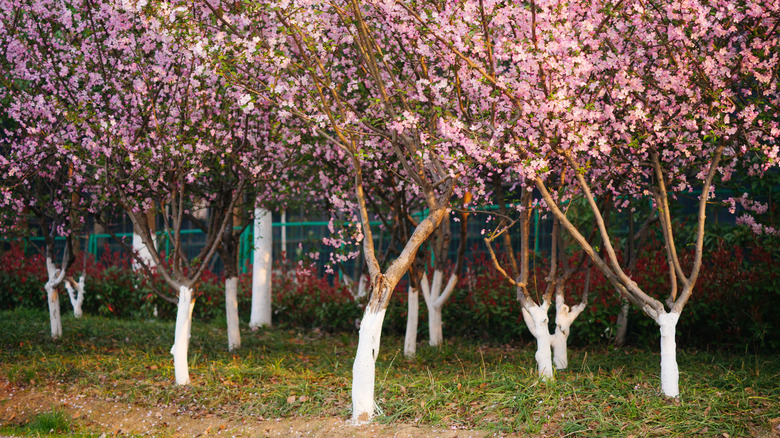
Pest and rodent control are also reasons why some people choose to apply white paint to the trunks of their trees. White paint is used to prevent tree borers, in particular, and does so in a few different ways. For one, tree borers tend to target trees that have been afflicted by sunscald. The white paint helps prevent that, as we've discussed. At the same time, it provides a protective barrier to hinder boring activity. Some suggest it may also be a detriment to their ability to lay eggs in the tree.
A layer of white paint can also make it difficult for insects and pests to climb the tree trunk and makes it less appealing for foragers such as deer and rabbits to nibble on the tinder bark. While it effectively makes life difficult for some pests, it works to confuse others. Rodents such as mice and voles are often willing to chew on trees regardless of any protective coating, especially in winter when other options are limited. However, when snow is covering the ground, it is thought that tree trunks painted white blend with the snow and confuse the rodents.
While these are each valid and practical reasons why some tree trunks are painted white, others receive a coat of paint sheerly for aesthetic purposes. White paint extending up the trunks of trees at an equal level gives an image of uniformity and neatness that many desire. Sometimes the trunks of trees are painted white simply because someone likes the way it looks.