

How Much Firewood Do You Really Need To Keep Your Home Warm All Winter?
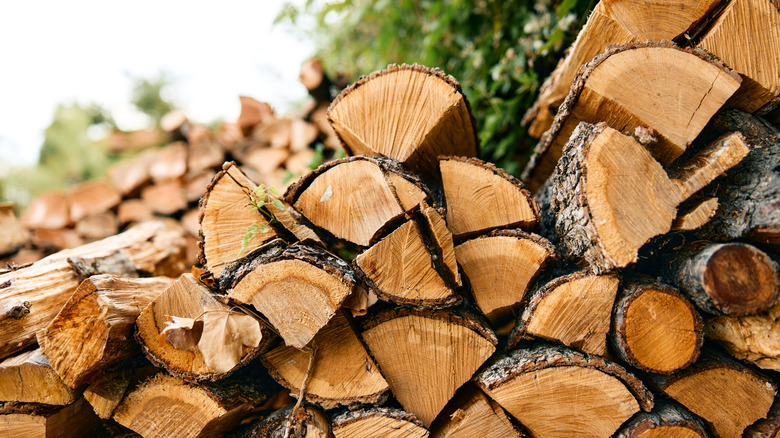
As the chilliest months of the year are upon us, many turn to their wood-burning fireplaces and wood stoves as an instrumental heat source for keeping their homes toasty while winter weather roars outside. But if you've recently moved to a new home or are a firewood novice, it's understandably tricky to figure out how much wood you'll need to keep the crackling fire going all winter long. So is there a trick or mathematical equation you can use to calculate just how much firewood your home will burn through in a season?
While there's no magic formula that will tell you the exact number of logs you'll need, there are some guidelines for calculating a reasonable ballpark. The general consensus among experts is that, in a colder climate, you'll need about two to three cords of wood to be the season's primary heat source for 1,000 square feet of space, whereas one to two cords will suffice for the same size area in warmer regions. This means that a 2500-square-foot home in Wisconsin might need up to seven or eight cords, while a 900-square-foot North Carolina bungalow might only need one or two. When in doubt, round up to the nearest full or half cord of wood, as it's far better to be overprepared than shivering.
But here's where things get complicated. While using this general framework can get you fairly close, it's important to consider the many variables prior to ordering firewood so you can adjust your estimate as needed. These include your climate, usage, insulation, wood type, and stove efficiency, to name a few. So let's dive into all the nitty-gritty about how to best guesstimate your firewood needs for heating your home until the end of winter hibernation.
Adjust your firewood quantity based on local and home-specific variables for a more accurate estimate

While the quantity guidelines are a good starting point, it's important to account for any variables that will alter the actual amount of firewood your home needs to last the season. Your location and weather are obviously factors beyond the aforementioned cord amounts. The colder the temperature outdoors is when compared to your interior temperature, the more wood you'll need to keep things heated. So if you live somewhere with frequent below-freezing temps, bump up your firewood numbers to be safe. Additionally, the recommendations are based on using the fire as the primary seasonal heat source. If you're using it as a secondary source only at night or on occasion for entertaining, reduce your quantity as such.
Your specific home will also affect how much wood you'll use, from size to efficiency. Whether you're heating your entire house or prefer to warm a smaller area with zone heating, you'll need to adjust the square footage for your calculations. If your home has great insulation, you'll have a much easier time retaining heat than if you've got an old, drafty house, so adapt accordingly. Your fireplace or wood stove's efficiency also plays a role. Newer energy-efficient models require less wood while older classics burn through much more.
Lastly, the firewood you'll go through in a season absolutely depends on the type and quality of the wood itself. A dense, well-seasoned (properly dried out) hardwood like oak or beech is the best type of firewood for a long burn time and high heat output. For firewood veterans, reference the usage from previous years to fine-tune your anticipated firewood needs. When in doubt, contact a local firewood expert for more tailored regional recommendations.