

Stop Banging Snow Off Your Shovel: This Smart (And Simple) Trick Actually Helps
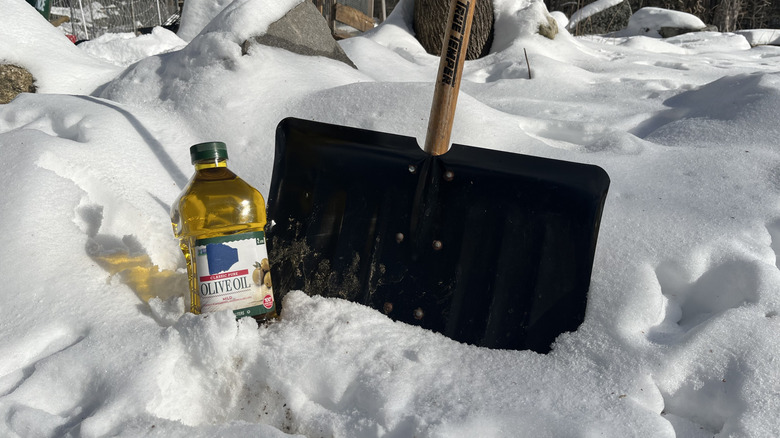
Where I live in New Hampshire, it is not uncommon to get storms that leave several feet of snow to clean up afterwards. While I have a snowblower and a friend who helps plow my tricky driveway, I still need to break out the shovel in order to make sure everything is cleaned up properly. Knowing how to shovel snow effectively is half the battle, but problems still arise. For example, I've spent many years, maybe a few too many, banging snow off of my shovel when it gets stuck. Instead, what I should have been doing was coating the blade in a lubricant to keep the snow from sticking to begin with.
If the shovel blade is warmer than the snow, the snow will melt on contact and then refreeze into a slush that sticks to the blade like superglue. Adding lubricant to the blade breaks that surface tension so that the blade becomes too slippery for the slush to stick to. Many people have used that old garage staple WD-40 for this, but it's actually simpler and more eco-friendly to use cooking spray – or even just olive oil.
This is a really excellent option, especially if you're someone like me with a bunch of kids who like to play in the snow. Using a natural product means that they are safe to play in the snow piles I've shoveled. Still, I bet you're wondering if this actually works. Well, here's the good news: I've personally been using this trick now for the last few winters (including during this most recent snowstorm) and can say with confidence that yes, it does.
Here's the best way to treat your snow shovel with oil
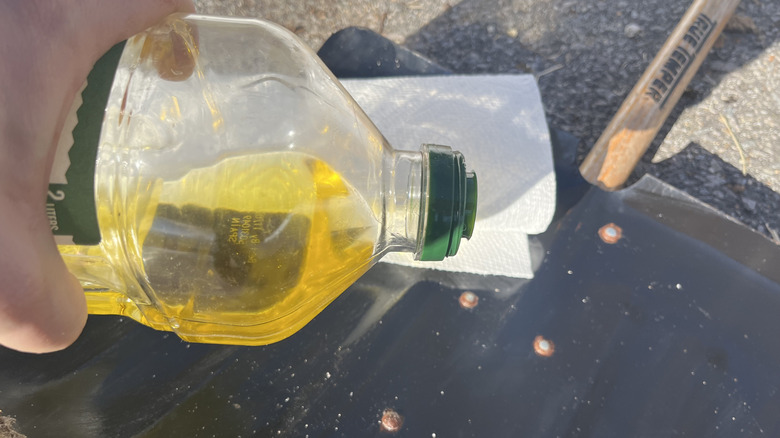
The beauty of this trick is that you don't need a lot of materials in order to make it work. You'll need a shovel, either plastic or metal, and some cooking spray. Before you go outside to shovel, give your blade a good coating with the spray. I've found it best to do this before you get dressed in your snow gear. Leaving the shovel to "cure" while you get ready helps the lubricant adhere to the blade better.
If you don't have cooking spray but have some cooking oil bottles, the process is a little more involved. Any kind of cooking oil — vegetable, avocado, or otherwise — will be sufficient. I use olive oil since it is the oil we primarily cook with.
Once you've got your oil, use a cleaning cloth or some paper towels and apply a good layer of oil to your shovel. Do this at least twice to allow a good film to build up on the blade. Like with the cooking spray, wait a few minutes for the blade to cure. Then, head on out into the storm and see just how easy shoveling becomes. I remember the first time I tried this I was almost angry that I didn't know about it sooner. It works great, especially when you're handling the really wet and heavy stuff. It just slides right off the blade.
Snow still sticking to the shovel? Here's what went wrong
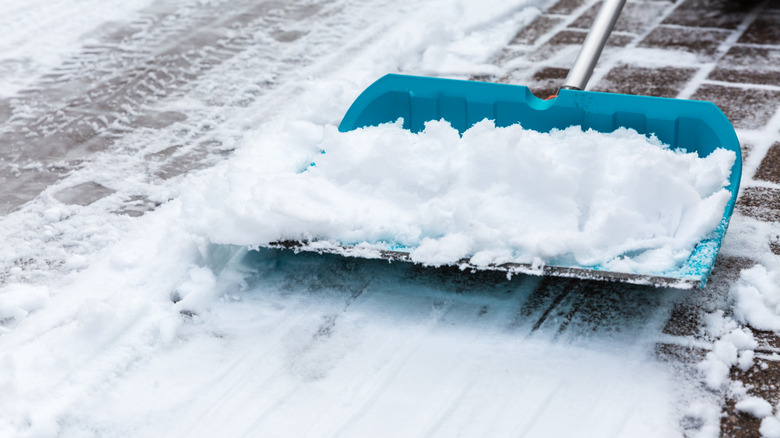
Whether you're shoveling your driveway or removing snow from a balcony, it's important to understand that there might be some issues that arise with your cooking oil trick. You might find that after a while of shoveling, the lubricant begins to wear off and that the snow will be sticking again. The main reason for this is that the snow is beginning to wash off the lubricant. This is an inevitable eventuality, and all that need be done is a simple reapplication. If you have a short driveway or walkway, this is not a problem. For longer driveways like mine, I've found it best to have two lubricated shovels to switch between once one starts to stick.
However, the primary reason you might find that the lubricant is not sticking is because you applied it to a warm blade. If you store your shovels in a heated area, the blade won't be freezing like the snow. It'll melt much faster and you'll get a sticky build up even if you've sprayed down the blade. You need to apply the cooking spray to a cold blade. It will adhere better and stay on the blade much longer.
If you'd rather reserve your cooking spray, you can use other household materials to lubricate your shovel. Apart from olive oil, I've also used car wax, and on one occasion, a full stick of butter. Both worked fine, but overall, I've found olive oil to be the most effective and easy-to-apply material for this trick.