

Level Up Your Kitchen Knife Sharpening Game With This Clever Sharpie Trick
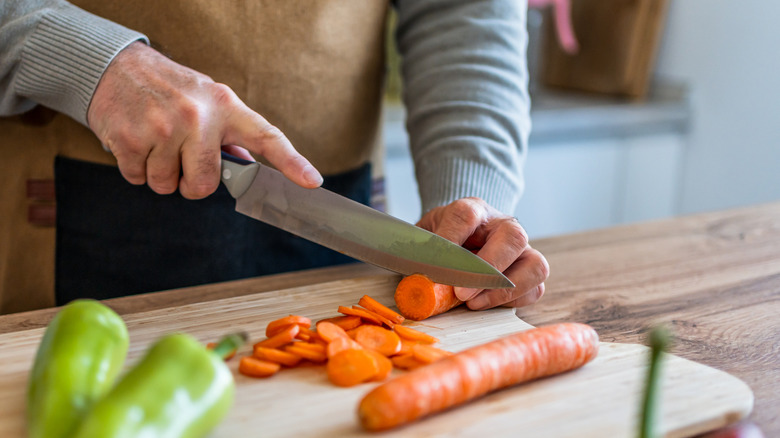
Sharpening a knife, whether you're learning how to sharpen one used in the kitchen or one I use in my shop as a professional woodworker, is a frustrating task — but it doesn't have to be. By using a Sharpie to monitor your progress, you can accurately see how you are sharpening the knife's bevel. Because a sharp knife is all about the bevel, or the angle at which the blade is ground to make the cutting edge very thin.
My old lutherie instructor, Larry Frye, explained to me that a perfect cutting edge should be infinitely thin and infinitely smooth — everything else is a compromise. The bevel grind also makes the thin cutting-edge uniform, so as to offer little resistance through friction. A knife gets dull as that cutting edge gets nicked up and deformed by use.
The secret to sharpening dull kitchen knives, therefore, is returning that edge to its thin smooth shape. We do that by removing tiny amounts of metal from the knife, eliminating the irregularities that have dulled it over time. But, you don't need to or want to change the angle of the bevel — which is where the Sharpie comes in.
How to use a Sharpie to maintain your knife's bevel
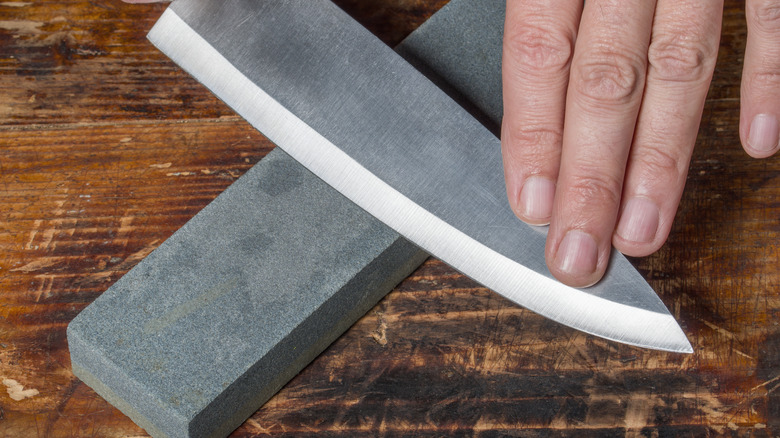
One of my mentors, British master woodworker Ian Kirby, explained to me that sharpening is metal working — it's not woodworking, cooking, or chemistry. To sharpen a knife, you need to grind away on the knife edge to achieve a consistent and effective bevel. The established bevel you'll find on your kitchen knives is likely to be perfect for the knife's intended use. For that reason, you don't need to change it. Sharpening using a Sharpie to guide you is a very useful technique.
By coloring the width of the bevel with the Sharpie on both sides, you can check to see if you are grinding away the metal evenly and removing sufficient material on both sides of the blade to reform the original edge. If you are only removing the Sharpie color from the top or bottom of the bevel, you'll need to readjust how you are grinding your blade. Grind the metal evenly on both sides, and you will soon have a perfectly sharpened knife.
I'm using the word "grind" to describe removing the small amount of metal as you sharpen. How you remove the metal is not as important as that you do it in a way that retains the bevel and creates a smooth edge. I prefer a diamond stone, but ceramic sharpeners, natural sharpening stones, or even a power grinder are equally good if you create a uniform smooth bevel that raises a thin sharp edge.