

Could Soil And Cardboard Replace Cement? Scientists Are Experimenting
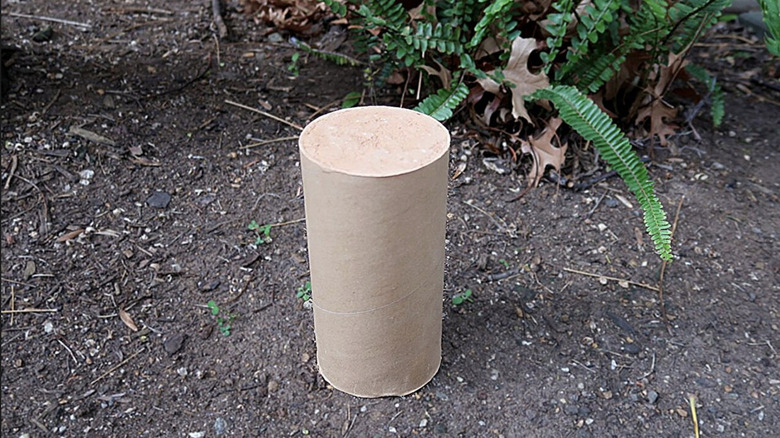
Though various types of cement and concrete have been manufactured over the course of history, it is only within the last century that their use has become widespread for civic and domestic construction projects. But before you go preparing the ground to take the concrete slab for your new patio, you might be curious to find out that scientists are experimenting with replacements for cement that, they claim, could change construction forever: rammed earth tubes, which are essentially recycled cardboard tubes filled with water and soil.
It's no secret that modern cement manufacturing is not the most sustainable business in the world and that cement accounts for a vast amount of construction waste. An article published in Structures Magazine by researchers in Australia posited that a more sustainable method utilizing rammed earth tubes could be the key to a more eco-friendly construction industry.
This is promising because both are readily available materials, and soil also has a long history of being used as a building material. But can this method really be used to replace cement completely? Is it as structurally sound as high-performance concrete? The scientific experiments being conducted would suggest a positive answer, but only for certain types of buildings.
Is rammed earth cardboard construction the future?
If there is one element of traditional construction that you cannot outsmart, it's building materials. While rammed earth construction is nothing new, the studies performed by researchers at RMIT indicates that the combination of recycled cardboard and packed earth could provide a vast improvement to the modern construction industry.
The method put forward by the studies is simple: turn recycled cardboard into strong tubes that will hold packed earth forms. The packed earth contained within the cardboard has been proven strong enough to serve as the foundation for low-rise buildings. Plus, the studies also point out that using this method would be more cost-effective than cement construction because cardboard is affordable and light to transport, and the earth can be sourced onsite. This reduces the need for numerous materials, which could, in turn, make construction and housing costs more affordable.
However, it needs to be pointed out that these ideas are only in the beginning stages and can only be applied in certain regions. Rammed earth has been historically used in hot, humid, or arid environments thanks to its ability to hold heat at night and be cool during the day, and researchers remain unsure whether it will hold up in other conditions. So, while we can't write off cement completely, it is good to know that alternatives are being put forward for a more sustainably built world.