

The Genius Trick You Need To Prevent Wood From Splitting During Any Project
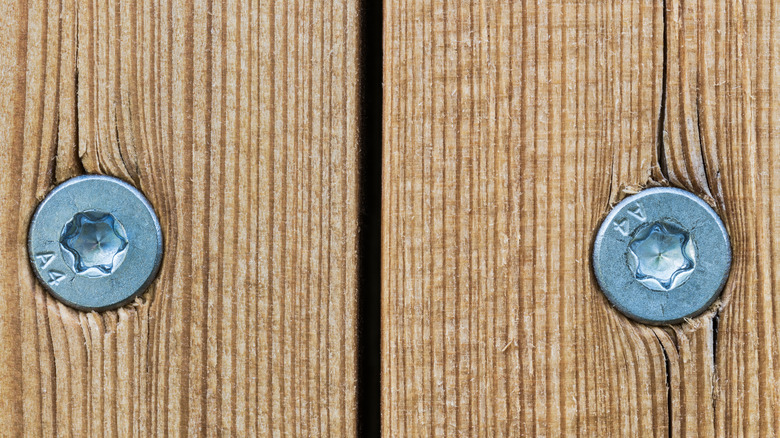
Unless you have a lot of time and patience, don't ask me about what an amazing, versatile, and underrated material wood is. As a professional woodworker, I've got stories. There was a time in history when nearly everything was made of wood: shoes, kitchen utensils, wagon wheels, you get the drift. One reason wood remains such a ubiquitous material is that it's widely available and easy to use. Arts and crafts, home repair, or gardening — people think nothing of grabbing a piece of wood and getting busy. With that said, one characteristic of wood that's frustrating for DIYers is its tendency to split, especially when driving a screw through the material. But, with proper technique, such as drilling a pilot hole or using wax, you can avoid the splits.
Wood splits because of how it grows. The fibers that make up the substance of a tree are like a super-compressed bundle of straws, running from the bottom to the top. Those fibers (the "grain") run the length of a board. When you drive a screw or even a nail (whichever is right for your project) through a board, basically, two things can happen: The fibers around the screw or nail will compress, allowing it to pass through the wood with the board intact, or the board will split.
Splitting occurs when the fibers do not have the ability to compress sufficiently to allow the fastener through, and the board fractures where two of the "straws" adjoin. Splits happen often at the ends of boards because the "straws" lack the continuity (and hence the strength) of long, continuous fibers. Now, let's talk about how pilot holes and a bit of wax help solve this problem.
Simple solutions for wood splitting

One way to stop the wood from splitting is to drill what is called a pilot hole. It is a hole drilled through the wood at the location where you want to place the screw. When using the screw to attach something to a piece of wood (a shelf, plaque, hinge), the diameter of the hole should be sized so the threads of the screw will engage the wood, but the shaft does not compress the surrounding wood fiber. The threads (which come in different sizes) are sharp helical ridges that wrap around the screw.
If you're using a screw to attach one piece of wood to another, drill a clearance hole in the one (sized to allow the screw body to slide through the hole,) and a properly sized pilot hole in the second. The threads will pull the pieces together, and the screw head will grab and secure the screw to the first piece. A second trick, to further split-proof the wood, is to rub the screw threads in a bit of wax for lubrication, making driving the screw home easier and helping prevent a split from happening.
Drilling a clearance hole paired with a properly sized pilot hole is the proper way to attach pieces of wood together. It prevents splitting and creates the strongest possible joint. But from professionals like me, to most DIYers, it is common to not drill a clearance hole or pilot hole, especially with new self-drilling screw designs. Often, we get lucky, and it works. But, to be clear, you are tempting fate. If it fails and you get a split, now that you know the proper way to do the job, the failure is on you (or me!).