

The Simple Hack To Remove Weeds Growing In Cracks And Pavers In A Pinch

Weeds growing in the cracks of concrete or between pavers can be highly frustrating — not just because they're ugly to look at, but because they can also cause long-term structural damage and make surfaces unsteady by shifting them. This is far from ideal, and it can often leave people overwhelmed by the process of weed removal. If you don't have the time to go out and buy the proper tools needed to remove weeds in a safe manner, you can always do quick maintenance with a tool you might have at home: a paint scraper.
Using a paint scraper for quick weed maintenance is quite easy. While a temporary fix, this is still effective in tidying up the appearance of your concrete or paver space. To remove weeds with a paint scraper, simply insert the sharp end as far as you can into the cracks in your concrete or between your pavers, then cut and scrape out the weeds. You should remove as much of the plant as you're able and be careful not to leave any residue, as that could encourage more growth. It is important to note that this is not a permanent solution, and it will likely only weaken the weeds rather than kill them entirely.
How to permanently remove weeds
Even though a paint scraper is a convenient temporary solution, you may still be searching for a simple, lasting fix that'll keep weeds out of your pavers and cracks for good. If you're not looking to spend too much money and you didn't mind the process of using a paint scraper, you can always buy a similar, but more effective, tool: a crack weeder, also called a weeding knife. Just like a paint scraper, you should insert the knife into the crack in your concrete or the space between pavers. The key difference with the crack weeder is that you will run the knife lengthwise and sever the weeds at the roots, using the hooked end to scoop out the entire plant and killing it entirely.
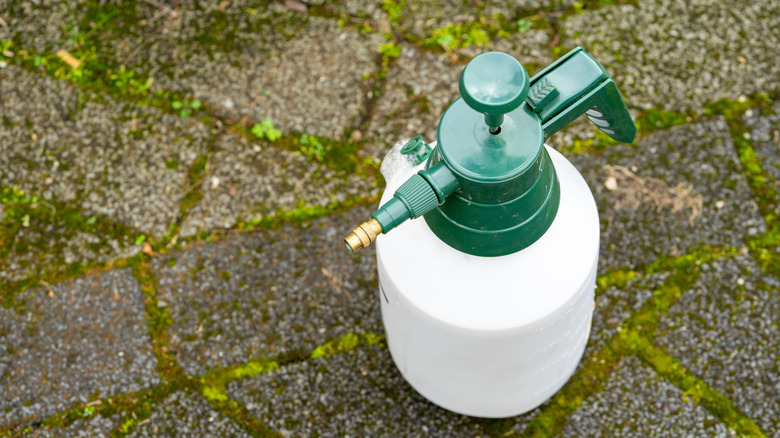
Another quick and inexpensive solution is to kill weeds with vinegar. By mixing a gallon of vinegar with a cup of castile soap and putting it in a garden sprayer or spray bottle, you can create your own homemade herbicide. Make sure you thoroughly spray weeds on a warm, dry day. If you can, you should also try to target younger weeds as they'll be more affected by the vinegar solution. You can use nearly any vinegar you have to hand, as most household vinegar contains around 5% acetic acid — but stronger types will be more effective against weeds.