

If You See A Tree Painted Orange, Don't Ignore It — Here's Why
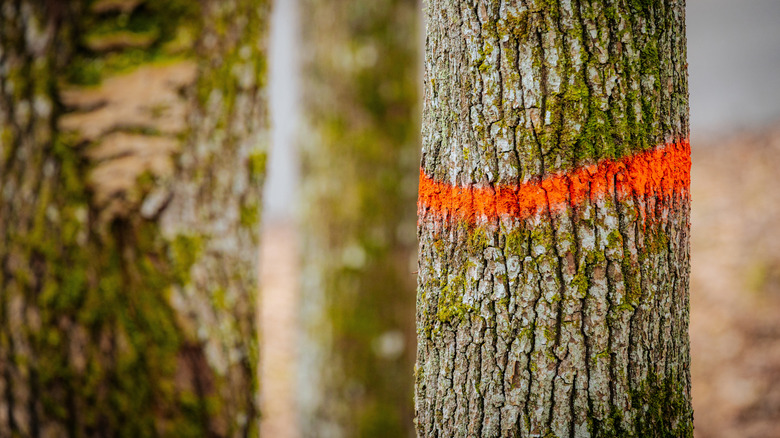
If you're a hiker, you may know that "blazes" are indicators on trees or rocks that mark your trail. Hikers can make their own temporary blazes using chalk, but there are more permanent ones painted on trees for a variety of reasons. White blazes have marked the historic Appalachian Trail since the early 1930s. Blue blazes indicate that there's a spur trail that may lead to a campground or point of interest. The "AT" also uses yellow, brown, green, and other colors. Multiple blazes might mark a change in direction, the end of a trail, or another change. But these markings aren't limited to just trail directions. If you see a tree painted purple, this could indicate a boundary tree on someone's private property. But what if you see a tree painted with an orange mark? Like its purple counterpart, it is likely not a trail marker but an indication that the tree has been selected for some sort of management, and you could be in trouble if you damage or cut it down.
If you're on federal land, the U.S. Forest Service uses orange markings to indicate "leave trees," which are trees that should be left standing when timber is harvested in the area. Leaving a handful of trees is important for the forest to regrow after clearcutting. "Leave trees" are also marked orange because of their importance for maintaining the integrity of the wildlife habitat. Even dead trees can be marked orange if they support wildlife. Trees marked orange might also indicate the boundary of a federal cutting area, meaning they shouldn't be cut down either. The Forest Service marks boundary trees with three orange horizontal slash lines at eye level, while "leave trees" are marked with an orange band around the trunk.
Decoding Orange Markings on Trees
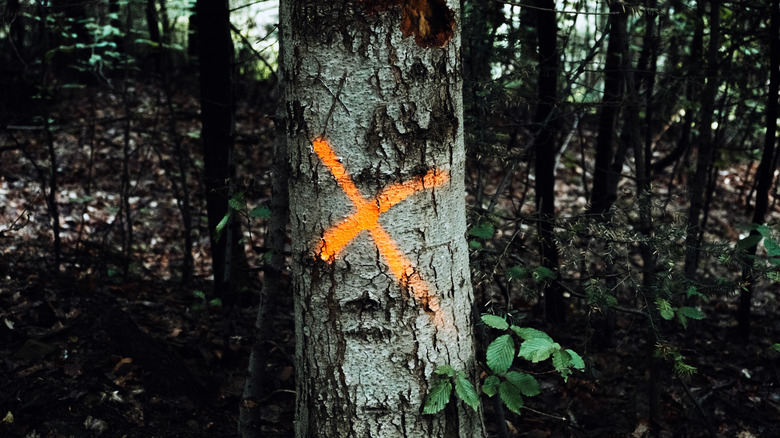
Don't be confused, though. There is no national color code for marking trees, and so there are meanings beyond those of the U.S. Forest Service for marking trees with orange that are not on federal land. For example, in New Jersey and Pennsylvania, some state hiking trails are designated with orange blazes. It's also easy enough for vandals to paint trees with different colors in order to confuse hikers, as happened in 2023 at Acadia National Park in Maine. On private property, landowners often make whatever arrangements they want with foresters to use certain colors to denote property lines, harvesting, or other meanings.
You should also pay attention to the shape of the mark painted on a tree. In Washington, D.C., an orange dot means the city's Urban Forestry Division plans to remove the tree. In Michigan, trees meant for harvesting in logging operations are marked with a long orange diagonal slash. Orange can also indicate removal for upcoming utility work, as is the case with a large orange X marking from California's Pacific Gas & Electric utility district. There could be many reasons for removing a tree, like infestation by the emerald ash borer, which is a serious ash tree problem. Cities might even enter private property to remove these trees. Trees might be damaged by rot, lightning strikes, or disease, may obstruct utility lines, or may be thinned to provide for new growth. Laws also allow registered arborists to remove invasive trees that are banned in several U.S. states. If you come home from work one day to find a tree in your yard marked with a large orange mark, now you'll know why. It is best not to ignore the orange markings and remember to just leave the tree alone.