

Lowe's Vs Home Depot: Are They Actually That Different (And Which Is Better?)
We may receive a commission on purchases made from links.
Lowe's and Home Depot are the two largest home improvement retailers in the United States, each making billions in sales every year. The first Lowe's opened in 1921 in North Carolina. According to a press release from Lowe's, by the end of January 2025, it operated 1,748 stores. The company expects total sales to reach north of $83 billion by the end of 2025. Home Depot first opened its doors in Atlanta, Georgia, in 1979. According to the company's annual report for 2024, sales at its 2,347 North American stores were $159.5 billion. In many ways, the two companies clearly have similar business models. There are differences, however, that might be worth considering, depending on your brand preferences, style choices, or budget.
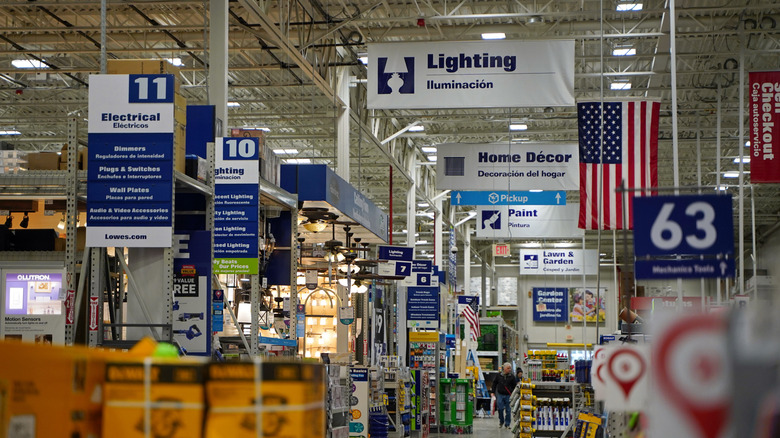
If you were plunked down in the middle of either one of the stores and didn't notice the company's logos or branding, you might not know which of the two stores you were in. Each offers more or less the same categories of products, similarly arranged in warehouse format, and each offers competitive prices. The lower cost the product, the more closely the two stores' prices match each other, so if you were merely shopping for garden rake or a stud finder, the main criterion for which store to go to may be which one is closer, and it's likely not hard to find either store near you. But when it comes to larger items like major appliances or expensive tools, the brands are often different and the prices can vary.
Similarities between Lowe's and Home Depot

The two stores clearly watch and match each other's policies, services, and prices. Return policies at Lowe's and Home Depot are nearly identical. Both stores also offer a suite of delivery options and installation services on items like appliances, doors, and windows. Where each store carries the same line or brand of products, their prices are very similar. Shopping online, you're likely to find that 8-foot 2x4 studs carry a similar price. The same DeWalt cordless driver was recently $199 at both stores, and the identical Maytag washer was $598 around the time of publication. A single 12-ounce can of WD-40 was $8.68 at Lowe's and only $0.10 more at Home Depot. But minor differences in price may add up if you're buying items in bulk: A 5.6 pound bag of Scotts grass seed was $34.98 at Lowe's and $33.67 at Home Depot. So, keep an eye on their competitive pricing if you need to buy a lot of something.
Discount policies are also similar at each store. At both Home Depot and Lowe's, verified active duty military, veterans, and their spouses receive a 10% discount on eligible purchases. Both stores offer discounts to teachers and seniors, while professionals like contractors receive volume pricing, exclusive discounts, and business tools to monitor their expenditures and analyze spending patterns. Members of the MyLowe's Rewards program and Home Depot's Pro Xtra Loyalty Rewards program receive exclusive offers and earn points toward eligible purchases. One-day-only "deals of the day" are available online while supplies last, and members receive weekly ads for discounts on hundreds of items at local stores. There are also virtual clearance aisles online with marked down prices.
Differences between Lowe's and Home Depot
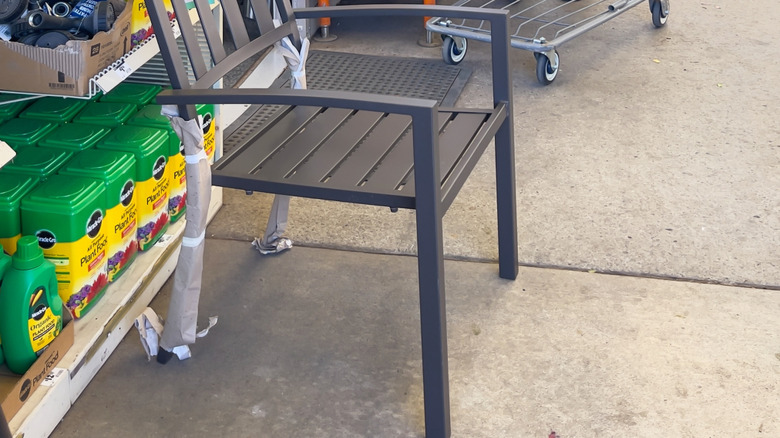
Differences in price and quality arise because for many items, the two stores carry different brands. Even where prices are nearly the same on comparable items, options can vary in terms of style and quality. If you want to find Pegasus faucet parts, you have to go to Home Depot. Lowe's carries Pella windows; Home Depot carries Andersen. Home Depot carries paints primarily from Behr and Glidden; Lowe's sells Sherwin-Williams and Valspar paints. Each store carries different brands of electric lawn mowers with widely different prices on models with the same specs, which is when it pays to compare reviews of the competing products to see which is the better value.
As of 2024, Home Depot and Lowe's combined made up about 32% of the market — meaning you have many choices on where you shop for your home improvement goods, and there are times when you might want to avoid buying from either Home Depot or Lowe's. Based on their economies of scale, big box home improvement stores can offer lower prices than smaller, independent stores, but that may not always be a good thing. With their national and international supply chains, their garden centers can carry plants from other parts of the country, which may not be best suited for your local environment. A local garden center is more likely to stock a wider selection of locally or organically grown plants. It's also easy to get intimidated when buying lumber, and if you can't find a knowledgeable employee at either store who can give you decent advice, you might be better off going to a local lumberyard. You may pay more at a local business that's had the same employees for decades, but the quality of the products and services they offer may be higher.