

Not A Riding Mower: This Is The Best Type Of Lawn Mower For Sloped Yards
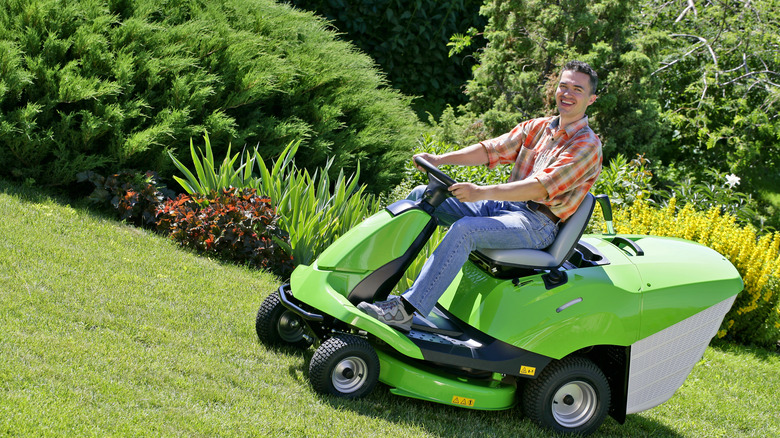
If you've ever driven a riding lawn mower up or down a slope, you'll admit it's dangerous. While they're convenient and time-saving on flat, level land, riding mowers can tip over on steep gradients due to poor traction, taking you down with them. It gets riskier if the slope is rough, too. Wheels can get stuck in holes or snag on debris, causing the machines to roll over on their side. Sharing similar concerns, Bryan Clayton, the CEO of GreenPal, highlights in his exclusive interview with Hunker, "When mowing on a hill, you have to be really careful, especially with riding lawnmowers."
Rather than risk injury while mowing a sloped turf, he recommends switching to a push mower. "As a homeowner mowing your yard yourself, your safest bet is just going with a push mower," explains Clayton. Since you're in full charge of the machine and can maneuver it across the slope, it can offer better control and traction. While certainly traditional and labor-intensive, it's much safer. As a bonus, it's far cheaper than a riding mower.
Mow sloped yards with push mowers
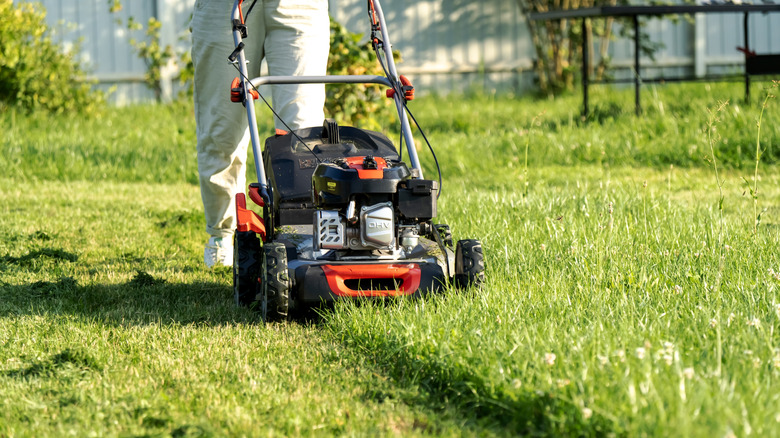
Before mowing a sloped hill, you should determine its gradient over a 10-foot distance. An inclinometer app on your smartphone can help with the measurements, though if you've got a friend to help out, you can measure it yourself by stretching a tape along the slope and holding up a yardstick at its bottom. This rise divided by 10 (the distance) should give you the slope. If it exceeds 20 degrees, know that it's time to make a switch from riding to a push model. "Pretty much every residential riding lawnmower you buy from Lowe's or Home Depot will be terrible on any slope more than about 20 degrees, and if it flips over, it's going to be really, really nasty," states Clayton. However, to be 100% sure, check your mower's permissible incline limits, as mentioned on the label.
Although applicable to professionals, even OSHA guidelines state that for hills with a 22-degree slope or higher, it's best to use push mowers or other specialized tools (think string trimmers or slope mowers). For push mowers, Clayton recommends "any mid-grade push mower Toro makes, or, if you can afford a little more, any Honda mower is worth the extra money." To further save on your effort, you might also consider self-propelled or walk-behind models. "Go with the 22-inch deck, self-propelled, with or without a bagger, and that's your safest bet for dealing with hills," he adds. Without relinquishing full control, you get a powered tool that's highly stable on slopes.
For large terrain, get a used professional walk-behind mower
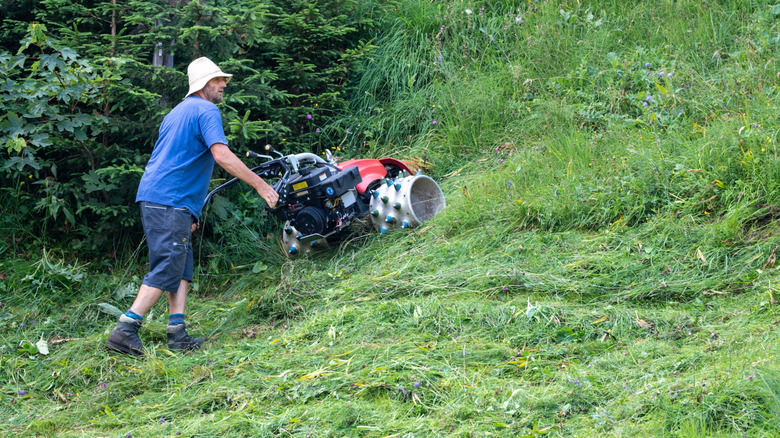
While self-propelled mowers certainly help take some strain off the body, their limits become evident in extensive areas. "Well, let's say you have a huge yard with a huge hill, and you want to mow it yourself. You can't push-mow all of that, and the hill is too steep for your typical John Deere riding lawnmower that you would buy from a residential supplier," says Clayton. "The next best thing is buying a used walk-behind lawnmower for professional use."
According to the lawn care expert, most lawn care professionals pick their mowers from XMark, Skag, or Hustler, and they cost a pretty penny — their price can easily exceed $10,000. But he adds, "The good news is you can find a good used one, something with about 1,000 hours on the hour meter for about half of that price." Online marketplaces are some of the cheapest places to buy a lawn mower that isn't the hardware store. Compared to residential models, professional variants have bigger decks and can cover the area quickly. "It has a 48-inch deck, and it will allow you to tackle that hill in about a third of the time that it would with a push mower," explains our lawn care expert. Or, you can landscape a slope even on a very small budget with groundcovers that won't require mowing.
That being said, remember you need different techniques for a riding and walk-behind or push mower. Riding mowers are driven up-and-down the slope; push mowers are moved across or perpendicular to the grade to minimize the risk of slipping underneath them.