

Lasts Longer Than Plywood: This Durable Material For Shed Siding Looks Better
We may receive a commission on purchases made from links.
It may be just a utility building, but if you're going to build a shed in a prominent location on your property, appearance is often as important as functionality. Moreover, many sheds end up getting converted to ADUs many years after being built, and the transition is much easier when the shed is built with quality, long-lasting materials. Siding is particularly important, because it's the most visible part of any building and the one most exposed to the elements.
Plywood is a popular material for building sheds, especially T1-11, which can be milled to mimic rough-sawn, vertical boards. An even more attractive option is to skip the mimicry and go for real wood, and when you choose redwood, you get one of the most weatherproof wood siding materials there is. Redwood, like cedar, contains natural oils that resist rot, even when unfinished, and it won't warp and de-laminate like plywood might when exposed to moisture. It's long-lasting, too, with quality, well-maintained installations lasting 75 years or more, compared to 20 to 30 years for T1-11.
Redwood 1-inch siding and trim boards come in widths of 4, 6, 8, and 12 inches and can be milled flat or with tongue-and-groove or shiplap profiles. Prices vary and, according to Angi, currently run roughly $4 to $20 per square foot, depending on location (redwood is cheaper in the West, where trees are abundant). That's considerably more than ⅝-inch T1-11 (about $2.50 per square foot), so redwood isn't so much an economical alternative to plywood as it is a style and longevity upgrade.
Redwood siding's installation options and aesthetic perks
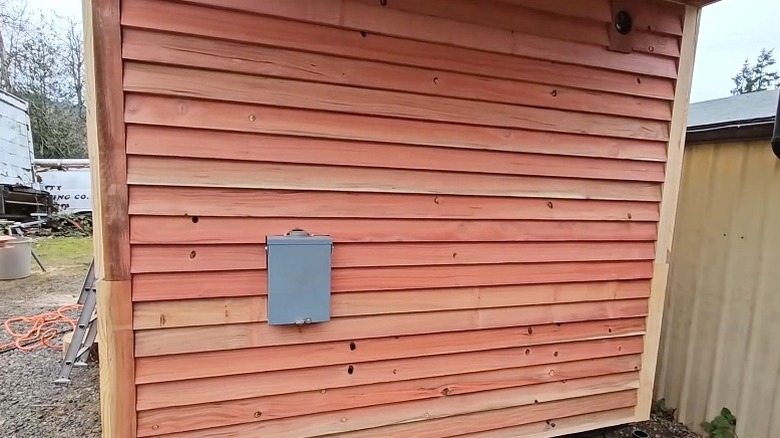
Redwood siding offers more design options than plywood, allowing you to lean toward more traditional or more modern looks as you see fit. One of the most common ways to install it is the board-and-batten method, which consists of flat vertical siding boards with 1-by-2s covering the joints between them. Another popular style is clapboard, whereby horizontal, tapered boards are installed with their bottoms overlapping the ones below them. You can also choose tongue-and-groove or shiplap boards and install them vertically or horizontally for a more finished look.
Because redwood is naturally rot resistant, many people choose to not paint the wood siding, instead leaving it unfinished and letting it turn an attractive gray. Over the years, it lends the property a rustic ambiance as it weathers. Those who prefer to preserve the natural colors give it a coat of varnish or some other clear finish with UV absorbers, such as Flood Clear CWF-UV Exterior Wood Finish. You can also stain redwood to provide sun protection without hiding the natural wood grain.
T1-11, on the other hand, needs paint or semi-transparent stain to look attractive and survive the years. Its top veneer is often fir, pine, or spruce — species with a washed-out whitish appearance that lack any of the earthy tones of redwood. Moreover, plywood is manufactured in layers, and without some kind of protective coating, they start to separate around the edges — a fault that's almost impossible to correct. If you prefer a natural rot-resistant wood shed to a painted one made from engineered materials, and you aren't on a budget, redwood is the better choice.