

A Man Transforms Wood Pallets Into A Stunning Picket Fence With Built-In Planters

When a pallet has fulfilled its original purpose, it can be a great source of wood for a DIY project. The quality of old pallets varies greatly, with some made from softwood, some from hardwood, and some from wood treated with dangerous pesticides. About 400 million wood pallets are made in the U.S. every year, so if you keep an eye out, you can often find good-quality, untreated ones to use for creative home projects. YouTube creator Woodworking Skill found some exceptionally good pallets, and he turned them into a picket fence for his front porch.
He made the pickets by cutting pallets in half. They are too short for a yard fence or a railing on a raised deck or porch, but they're just the right length for a ground-level porch. The design calls for planter boxes to support the fencing, and Woodworking Skill also made these from pallets. The result is an attractive addition to his concrete slab porch. It could also make an interesting border for a backyard patio or garden walkway.
One of the most interesting features of the design is that it doesn't call for posts. The sections of fencing are supported by rectangular planter boxes about 4 feet tall that sit on the concrete. If you wanted to install this fence along the border of a lawn or garden, you would need to bury the posts in the ground, and you could use the 4x4 material that comes on heavy-duty pallets.
Making a picket fence from pallet wood
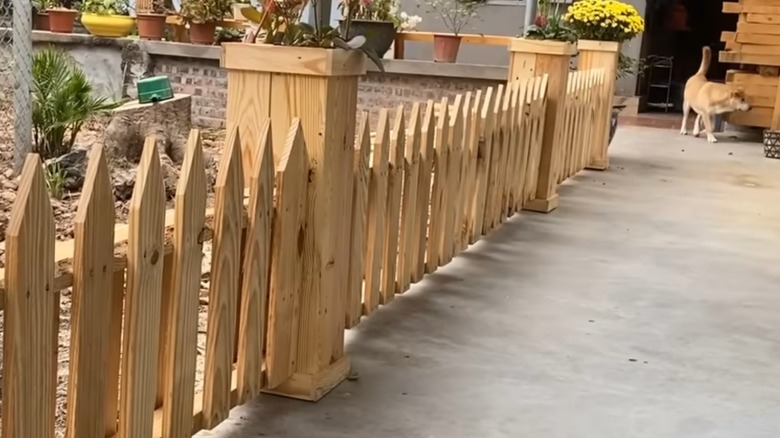
The pallets that Woodworking Skill used for this project were about 4 feet wide and made from regular, blemish-free fir or pine. They are much like the ECO pallets from SharkCrates (also known as stringer pallets in the industry), and they feature 1x4 boards nailed to 2x4 stringers. Woodworking Skill cut each pallet right down the middle with a circular saw and trimmed the boards at the bottom, which made two fence sections with 2-foot pickets. He cut triangular shapes into the tops of the pickets with his saw.
The next step was to cut the offcuts into short, uniform boards about 6 to 8 inches long and nail these to 4-foot corner sections to make the sides of the planter boxes. After completing four of these sections, he nailed them together with a nail gun. He added 1x2 lumber around the top and bottom of each planter as trim.
The final step was to screw wooden holders onto opposite sides of each planter box and fasten the fencing sections to those holders. He finished up by applying a clear spray finish to protect the wood. Something else you can do is add a liner to the planter boxes before planting. The finished fence adds a decorative border and space for plants while giving old pallets a new purpose.