

They Use An Old Trampoline To Build A Backyard Moongate With An Impressive DIY

If you can't remember the last time your kids played on that old trampoline, it's easier than you might think to turn the backyard eyesore into an enchanting moongate. While evidence of the portal-like structures dates back thousands of years, impressive DIYers have found several modern ways to construct their own show-stopping gateways. Essentially, the project involves removing the net, mat, springs, and pad of an old trampoline before partially burying its metal frame into the ground. The end result is a decidedly minimalist form that can be covered with climbing plants or string lights to achieve a whimsical look.
Most garden arbors and trellises can enhance your outdoor space, but professionally installed trellises can cost hundreds or thousands of dollars. Trellises also need secure anchoring to prevent them from falling under the weight of plants or strong winds. Using an old trampoline to build a backyard moongate solves both of these problems. For starters, you can either repurpose one you already have or find one on Facebook Marketplace for cheap (or even free!). Metal moongates at garden supply stores can cost hundreds or even thousands of dollars. But compared to building a stone moongate, there's no doubt using an old trampoline can save you time.
However, there are some important things to consider before getting started. The size of your trampoline will largely determine the height of your moongate. Measure carefully to make sure it will accommodate your tallest visitors, subtracting several feet from the diameter since the frame will be partially buried. And if you locate your moongate in a high-traffic area, remember to remove any rough or rusted edges to avoid injuries.
How to build an old trampoline DIY moongate

The main difference between repurposing a trampoline as a moongate and turning it into an archway is to maintain as much of its circular shape as possible. DIYers have explored several ways to do this. The simplest involves removing all but one of a trampoline's U-shaped bases before standing the frame upright in a hole dug at least 2 feet deep (or more, depending on the diameter of your trampoline).
Because trampolines are under an extraordinary amount of tension, disassembling one can be a dangerous job. Enlist the help of a friend, and work slowly to avoid injury. Start by removing any accessories, including ladders and safety nets. Review your manufacturer's instructions to determine how and where your frame is held together using bolts, screws, or clips. Wear heavy-duty work gloves while removing them with an Allen key, power drill, or rubber mallet. The most important (and injury-prone) step is removing the springs. Using a spring tool, carefully remove the springs opposite each other instead of working your way around to avoid unnecessary tension.
For a more substantial moongate, consider using two trampoline frames set into the ground parallel with each other. To add long-term stability, consider repurposing the discarded trampoline frame pieces to create cross-sections, ideally using the clips you removed during disassembly. Some DIYers who have used multiple trampoline frames to create arched tunnels between raised beds have wrapped them with heavy-gauge wire mesh, an approach that could also be used to enclose a moongate.
Customize a trampoline moongate with paint, string lights, or climbing plants
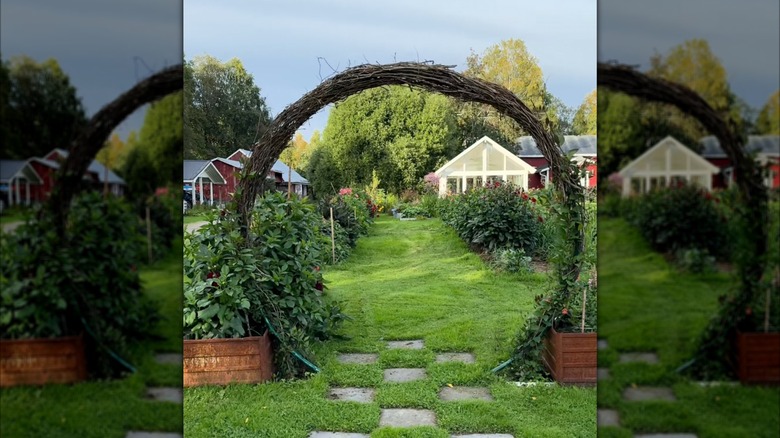
Even a bare moongate is a striking addition to most backyards. If you prefer a minimalist look but want to make sure it stands out, consider applying a coat of rust-resistant spray paint in the color of your choice either before or after you install it. Winding a simple strand of solar-powered string lights around the frame is another easy and low-cost way to customize your new DIY moongate.
If you're willing to invest a little more time and money, there are more unique flourishes you can borrow from DIYers who've attempted this project in their own backyards. Since most trampoline frames are made from galvanized steel, whether you use a single one or two of them, connected with wire mesh or additional framing, your new moongate will be sturdy enough to support woody climbing vines like wisteria or heavy vegetables that grow on a trellis, like squash. If you want to completely disguise your trampoline frame in just a few seasons, honeysuckle (Lonicera periclymenum) and grapevine (Vitis vinifera) are fast-growing options that can make your moongate appear to have grown right up out of the ground.
To achieve an even more whimsical look, consider using discarded wood scraps to build shelving inside your moongate around a central doorway opening. You can also create a strong sense of place by adding a rustic path leading to (or through) your moongate, flanking it with charming gnomes or other statuary, and positioning it so that your upcycled old trampoline frames a pretty view.