

Spraying Ceilings With Vinegar: What It's For And Why It's Recommended

Across cleaning articles and forums, people suggest spraying white vinegar onto ceilings. Though it may sound strange, spritzing this natural solution onto the ceiling is a common recommendation to combat mildew and mold growth. In humid parts of your home, like the bathroom or perhaps the laundry room, excess moisture without proper ventilation can lead to fungal growth. However, whether vinegar will work on your ceiling depends on what the ceiling is made of and the extent of the mold problem.
While online hacks should always be taken with a grain of salt, there's a reason so many people recommend vinegar for cleaning, and specifically for solving mold problems on a bathroom ceiling. Vinegar has natural antimicrobial and antifungal properties due to the acetic acid it contains, which can be capable of killing mold and mildew.
Vinegar can be a simple, effective solution for small amounts of mold and mildew on drywall ceilings. Unfortunately, more porous materials, like ceiling tiles, can become too overrun with mold to save and typically need to be replaced. Plaster ceilings may also be more porous and prone to deeper mold growth that vinegar can't reach. In some cases, the fungus can seep too deep into drywall as well, possibly requiring professional mold remediation. If you notice a few specks of mold on your ceiling, reach for your vinegar. However, if it continually returns after your cleaning routines or appears widespread, it's likely best to call in a professional.
Cleaning spots of mildew or mold from ceilings with vinegar
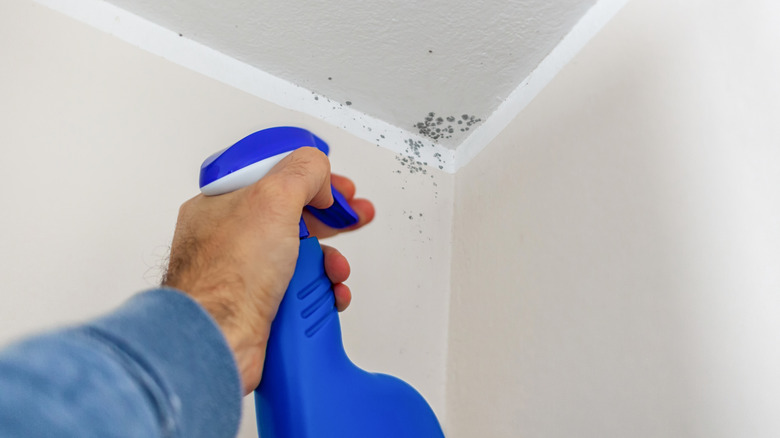
Exposure to mold and mildew can lead to health issues, which is why it's so important to get it off your ceiling right away. Before attempting to clean mold or mildew, it's crucial to take proper precautions. Fungi give off spores, making a mask essential to avoid breathing them in.
Consider placing a tarp below the affected area of your ceiling to catch any mold that falls as you clean. If there's just a little bit of mildew or mold on the surface of your ceiling, wet it with a solution of equal parts vinegar and water. After giving the vinegar about an hour to work, scrub the area to get rid of the growth. Rinse by using a clean, lightly moistened cloth to wipe the ceiling, or leave the vinegar to dry. Because these fungi cause odors, killing spots on your ceiling with vinegar should help your home to smell better, too (that is, after the vinegar smell goes away).
Some of the key differences between mold and mildew are where and how they appear. Mildew is often easier to clean and will be on the surface, while mold can cause more serious problems and grow deeper into your drywall. Vinegar is mostly suited to surface- and just-below-level treatment. If you discover that the problem is more extensive than you thought, contact a mold professional.