

The Reason Older Homes Have Tiny Doors Leading To The Basement
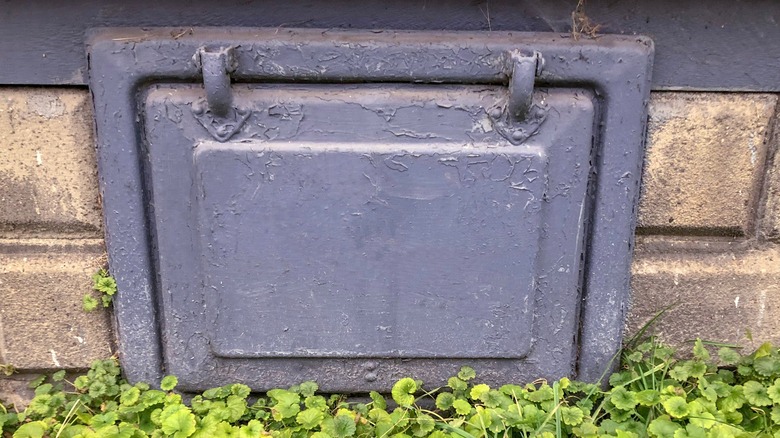
If you happen to spot a small metal door built into the foundation of an older home, you're not looking at a pet door, an entry to a child's bedroom, or a passageway for leprechauns. The door likely opens to a coal chute, and it's usually more of an historical curiosity than a working feature of the house. Why would a house have a coal chute? The answer is that it had a coal-burning furnace.
Coal was the primary fuel for home heating in the United States from the late nineteenth century until about the mid twentieth century. During that time, a coal-burning furnace was typically located in the basement, and just as milk trucks delivered milk and ice trucks delivered ice, coal trucks delivered coal. They would deposit it into the coal chute through the small door in the foundation, and from there it slid into a bin. The homeowner — or a hired hand — would then shovel the coal into the furnace to keep the fire burning.
Houses from that era typically have other obsolete or disused features that look strange by today's standards. Examples are porcelain insulators for knob-and-tube electrical wiring, laundry chutes, and the "Pittsburgh potty," which is a random exposed toilet in the basement with a mysterious purpose. One explanation for its existence was to provide Pittsburgh's steel workers an opportunity to clean up after work, but it's more likely that, being located in the basement, it was there to prevent sewage overflows on upper floors.
What to do with a coal door
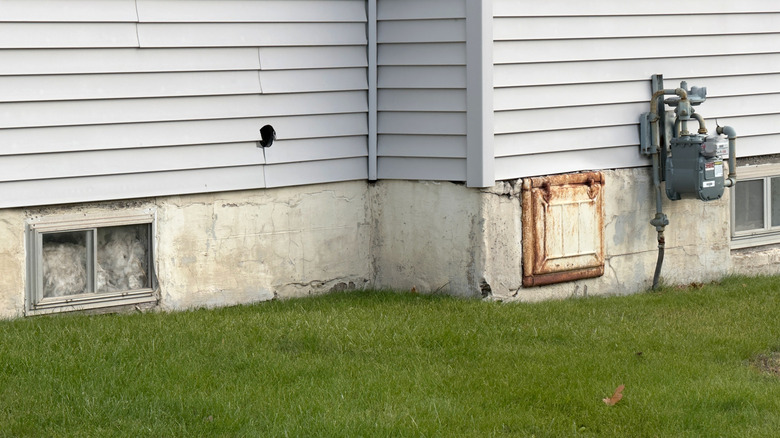
Coal is a more efficient source of heat than wood, but in today's electrified world, it's pretty much obsolete as a residential fuel, which begs the question of what to do with the built-in coal door. If left as is, it can become a source of leaks, especially if it's built into a well. Moreover, a small door that opens can be a hazard for curious children, and as it begins to rust while the masonry around it crumbles with age, it can compromise the structural integrity of the building.
The safest solution is to remove the door and fill in the opening with a material that matches the foundation, then pack soil around that part of the house's foundation and level it with a slight tilt away from the building for rain runoff protection. An easier option might be to spread construction adhesive around the inside perimeter — or overfill the cavity inside the door with spray foam insulation — and wedge the door shut with wood until the material sets.
A third alternative is to keep using the door — not for loading coal, of course, but for other purposes. You could turn your basement into a custom root cellar and use the door for transferring provisions in and out. You could do the same with gardening tools and supplies. You may come to appreciate your old coal door as an historical artifact that's both cool and useful.