

Man Uses PVC Pipes To Build A Trellis System For His Garden — And Just Wow
We may receive a commission on purchases made from links.
The internet is full of aspirational Pinterest-worthy garden spaces, meticulously outfitted with high-end raised beds, integrated irrigation, and impressive custom trellis systems. But thankfully, it's also filled with an endless supply of more attainable, affordable ideas for personalizing your home garden thanks to clever DIYs from online green thumbs. One such budget-friendly upgrade was shared by YouTube user Greens and Machines, who built an entire customized DIY trellis system out of basic, inexpensive PVC pipe and twine to provide proper vertical support for climbing fruit and vegetable vines to thrive. By constructing an outer support frame from custom-cut pipes to perfectly fit his space and then stringing jute twine vertically between the crossbars to support the vines, he was able to transform his garden in an affordable, beginner-friendly way.
For this DIY trellis project, purchase ¾-inch PVC Schedule 200 pipe in 10 foot lengths for the main trellis frame. This particular type of PVC pipe has the same outer dimension but a thinner wall than the typical Schedule 40 pipe typically used for DIY outdoor irrigation projects, allowing for a more lightweight frame and larger inner clearance dimension to fit your ground stakes. These stakes will be made from ½-inch PVC Schedule 40 pipes, cut to approximately 18 inches for each vertical post. Additionally, you'll need two ¾-inch elbow connectors for the outer end posts, as well as a T-shaped connector for every vertical post in between. Lastly, stock up on some jute twine to complete the shopping trip, and you're ready to construct your very own DIY PVC pipe garden trellis for your favorite climbing plants.
Planning you PVC trellis and cutting the pipe
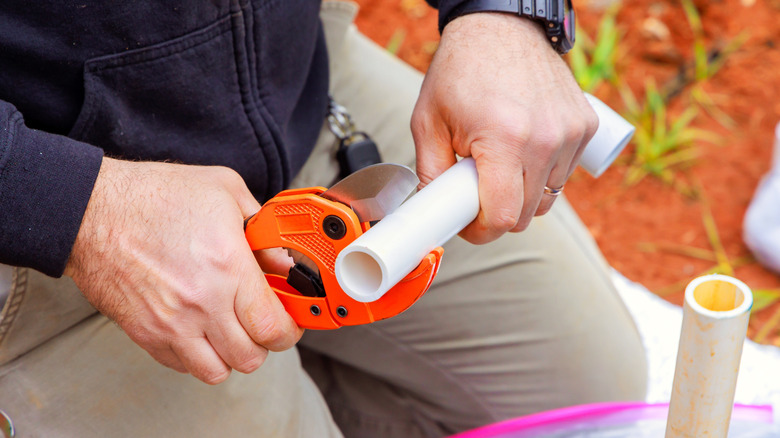
To create your own PVC garden trellis system, begin by planning out the spacing for the frame. The YouTuber opted to have four six-foot vertical ¾-inch PVC posts, spaced four feet apart, and connected by one upper rail, which spanned roughly 12 feet across the garden row. Since PVC pipes come in set lengths, such as the 10-foot option used on YouTube, everything was planned so that only one cut had to be made on each pipe to yield a six and four foot piece. However, they're sometimes sold in smaller five foot pieces for those who prefer not to cut at all and are okay with a smaller trellis. Adjust the spacing and height -– and therefore the pipe length and quantity required for the project -– as needed for your particular layout and plants.
You'll also need to cut ground stakes for each vertical post out of the ½-inch PVC pipe. The larger ¾-inch pipe slides over each ground stake for support. The YouTuber used about 18 inches of pipe for each stake, but feel free to adjust this depending on how many posts you need to accommodate, as well as how high you are making the trellis. The higher you go, the taller you'll want to make the support stakes. Make any cuts to all PVC pipes as needed with a pipe cutter, such as the Bates PVC Pipe Cutter, available for $9.95 on Amazon. Your local hardware store may be able to pre-cut them for you as well.
Assembling your PVC and twine garden trellis
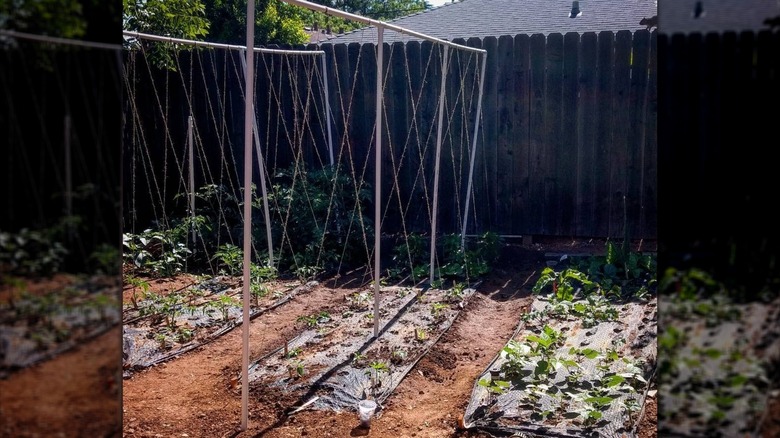
With all PVC trellis pieces cut, it's time to assemble. Begin by measuring for the vertical post locations. The YouTuber spaced them four feet apart, but you may wish to adjust this depending on your garden. Hammer the ½-inch PVC stakes into the ground about halfway. Slide each ¾-inch, 6-foot vertical pipe on top of the stakes so that they're held upright and straight. Use a curved elbow connector at the top of one end post and join it to one of the four foot upper crossbars. Use a T-shaped connector to join that crossbar with the top of the first middle vertical post. Continue across the top with additional crossbars and T-connectors until you reach the last post, where you'll use an elbow to terminate at the last post.
Next, grab the heavy-duty jute twine to form the interior plant supports. These are connected vertically from the PVC pipes, running down to the ground on a diagonal to form an "X" shape. If you have raised garden beds, you can use staples or nails to anchor the ends of each piece of twine to the outside of the bed itself. Alternatively, if you're working with gardens at ground level, you can use landscape fabric/garden staples, with or without the fabric itself as desired, to anchor the twine to the soil at the outer edge of the garden row. Beginning at one end of the trellis, tie a piece of jute twine to one ground anchor, wind it up over and around the upper crossbar of the PVC frame several times, then send it down the other side to another ground anchor. This will form a triangle with each piece of jute string to support climbing vines. Repeat this process every 12 to 18 inches, depending on your plant spacing, across the frame to complete the DIY trellis.