

The Popular '50s Wall Art Style That's Making A Big Comeback

We may receive a commission on purchases made from links.
When the style is called brutalism, it's hard to argue that any particular circumstance or practitioner gave it a bad name because the name was pretty bad to begin with. Lots of people now associate this post-World War II movement with its earliest architecture (usually enormous monochromatic concrete structures), which was co-opted by communist regimes and began to be associated with authority and the warehousing of people in characterless concrete monoliths. To be sure, some brutalist ideas worked their way into the characteristics of contemporary architecture, but there are expressions of brutalism that take place at a human scale and with more aesthetic delicacy, and one of the most accessible of these is wall-hanging sculpture, which is making a comeback that brutalist architecture will never fully accomplish.
It's common to attribute the recent uptick in interest in brutalism to Brady Corbet's 2024 historical drama "The Brutalist," which tracked the effect of architect László Toth's immigration to the U.S. But in fact, interest in brutalism in general (and, to a lesser degree, in brutalist interior design, wall art, and sculpture) has been steadily increasing over a 22-year period, and you can now find a resurgence of the movement's emphasis on bold, geometric forms and industrial texture in everything from graphic and UI/UX design to flower arranging, and even jewelry. This should surprise precisely no one. The softer organic warmth and fluidity of the recent neobrutalism movement outline a more relatable, biophilic, and human vibe that sets itself apart from the artificial and digital inauthenticity of modern online life.
Brutalism in metal wall art
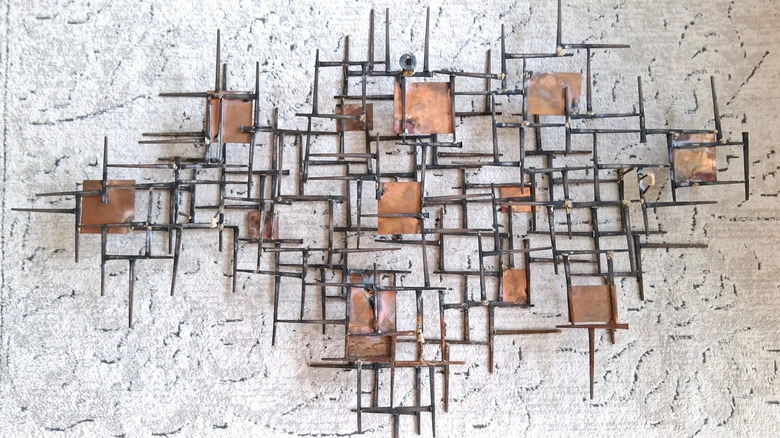
Brutalism was an expression of mid-century modern style that's often intertwined with minimalism, capturing the aesthetic preferences of a lot of today's design-conscious homeowners. But what does all that mean for wall art? When it comes to brutalism, this is a surprisingly hard question to answer. Brutalist design can be idiosyncratic, and you don't necessarily know brutalist sculpture when you see it. The softer, more organic (read: curvilinear) forms of neobrutalism exacerbate the problem by expanding the possibilities a lot.
Neobrutalism goes by a lot of names — soft brutalism, eco brutalism, and the like — but perhaps the most telling is "tactile brutalism." The work of well-known artists like brutalist sculptor Curtis Jeré (actually a sort of portmanteau of artists Curtis Freiler and Jerry Fels) presaged soft neobrutalism with its textures, organic and sometimes unfinished-looking shapes. There's no need for varnish, polish, or a veneer of microcement; it's ironic that, perhaps because wall art doesn't have to be touched, it is free to employ honest and real textures and forms. Neobrutalist metal wall art can be as interesting or even as harsh as it wants to be, yet still look approachable and quite literally touchable.
Of course, it was never all about texture. Early works like C. Jeré's "Seagulls" were pure visual delights, and it was more tempting to imagine touching rather than actually touching the sunbursts of Larry Casadevall, Harry Bertoia, William Friedle, and others. While brutalist sculpture can be large and harsh, variously resembling anything from a Jenga game to the Witch King's helmet, something about the flattening of it against a wall brings hanging sculpture down to earth.
Bringing brutalism indoors safely
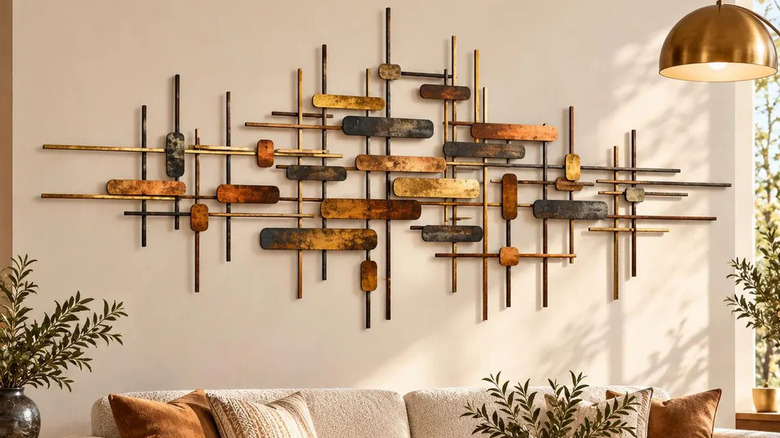
Getting a handle on such a broadly defined style is more a matter of practice than recognition. An afternoon spent recognizing the common forms of this designer-approved way to fill the wall above a sofa will help you see it in the most unexpected of places. For example, brutalist sculptors like C. Jeré, William Bowie, and (later) Mark Weinstein often employed a metal or cut nail grid sometimes overlaid with rough geometrical shapes, and similar works are common in places like Etsy and eBay. You can find echoes of the style in everything from Dansaekhwa-inspired Korean metal sculpture to generic geometric metal wall art. And it's also pretty easy to find reasonably priced authentic brutalist wall art.
Brutalism's iconic metal sunburst might be even easier to approximate because the more mainstream strains of mid-century modern design had sunbursts of their own, albeit less dangerous-looking ones. While a brutalist sunburst might look like a crown of thorns gone supernova, a flock of birds flushed out by the Eye of Sauron, or something growing from spores in a petri dish, you can approximate it with fairly mundane commercial metalwork.
Once you have the feel for it, you'll see it everywhere. Japanese Mono-ha had a lot in common with brutalism, as does folk art welded together by a grandmother in the next town over. Just as you will start seeing it everywhere, you can use it anywhere, introducing brutalist elements into mid-city modern or other modern aesthetics without missing a beat. And it's not out of the question to transform Dollar Tree items into stunning DIY wall art, brutalist-style.