

Keep Your Garage Warm This Winter With Lowe's Compact But Powerful Solution
All that stuff you need to get done in your garage doesn't stop when winter rolls in. When your shivering, cold-numbed hands reach a certain point, you're done until you can warm them up again. The solution is a space heater, and you have some options. The Cadet 4000-watt portable electric garage heater is worth a look if you need a heat source that stays out of the way while providing enough power to get you through your current DIY project or organizational jag.
Like pretty much any heater, the Cadet isn't much to look at. It looks like a lot of milkhouse and small cube electric space heaters, but it has some interesting and useful features. It comes with a bracket for mounting the heater on a ceiling or wall, and includes a fan delay that waits until the heater is up to temperature before kicking on and delays until the heating element has cooled before shutting off. Its corrosion-resistant powder-coating should protect it from the dampness and humidity of a garage, and it features a temperature safety automatic shutoff with a red over-temperature light. Being ceiling- or wall-mounted, it does not include an anti-tip safety feature common on space heaters meant for floors.
The Cadet produces over 13,500 BTUs — enough heat for 400 to 600 square feet of insulated space anywhere but Minnesota. Garages are, even in the best of construction, prone to fairly major air leaks and relatively poor (if any) insulation. That needs serious heaters — big, loud forced-air heaters often used for construction, tank-mounted propane heaters, freestanding propane space heaters, and similar but floor-standing electric heaters meant for construction.
Powering the Cadet 240-volt garage heater
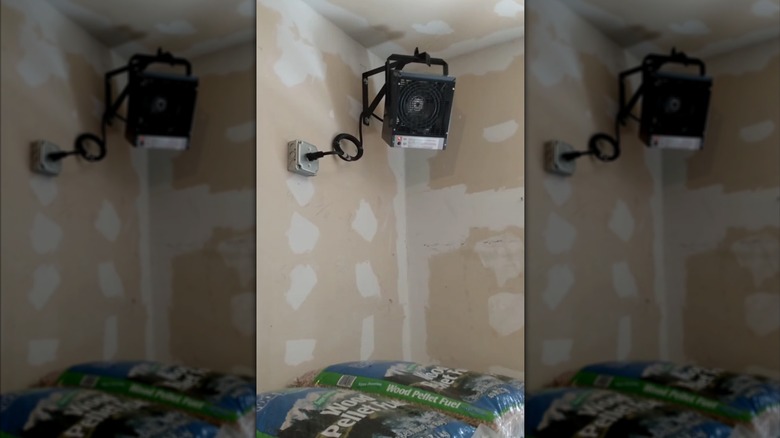
All those British thermal units require some power — 4,000 watts, to be exact, at around 16.7 amps. That's a lot of power, so using a space heater isn't necessarily a way to save cash. You'll also need to install a 240V electrical outlet rated at 20 amps — not the sort of thing you happen to have free in your average closet or bathroom.
This turns out to be a good thing, because your electric breaker panel can't be in either, and odds are that, short of running a generator all winter, you're going to need to add a 240V outlet for this heater. It's also possible that you have unused 240V circuits if you've converted from electric to gas hot water, for example, or abandoned a large mini-split. The luck to stumble on such outlets isn't usually found in your garage, so you'll probably need some new wiring.
The good news is that circuit breaker panels are often located in garages. Fortunately, garages are often left unfinished or only drywalled to what's called a "level one" finish (taping and a single application of mud at the joints, with no priming) to meet fire code. Finishing costs thousands of dollars and isn't a big concern for purchasers, and it can impact your property tax bill. The presence of a breaker panel and drywall that's easily repaired (if there's any drywall at all) simplifies wiring quite a bit. It's also possible to run a conduit outside of the wall, which looks a lot more acceptable in a garage than in your open-concept hyper-minimalist coffee table book display room.