

How To Add Privacy To A Large Bedroom Without Buying Curtains, Blinds, Or Dividers

Curtains and blinds are great at keeping the outside out, but they do nothing about the privacy problem inside a large bedroom. For instance, your bed may sit in full view of the doorway. Or, perhaps, your room feels more like a shared space, with a seating area in one corner and a work-from-home bedroom desk in another. Instead of bringing in a bulky divider to deal with this problem, use tall plants to add privacy to your room. As plant expert Henry Davenport of Hortology tells Livingetc, "Using plants as natural screens allows you to create serene, secluded spaces within your home, all the while preserving the open and spacious ambience of a room."
Think of them as a softer way to divide the room into different zones without making it feel smaller or enclosed. Large, leafy plants work nicely for this use because their foliage offers a degree of visual screening without completely closing off the space. Of course, you'll need to keep their watering schedule in mind and add plant mats or saucers to protect your carpets and flooring. That said, you can also use realistic-looking fake plants if you're on the fence because of the maintenance. They come as tall as 6 to 10 feet and look the same in a dim room as in a sunny one. Either way, just make sure your pots and planters go well with each other — whether that means choosing a matching set or mixing sizes and colors — and complement your room's decor as well.
Using tall plants to break sightlines in large bedrooms
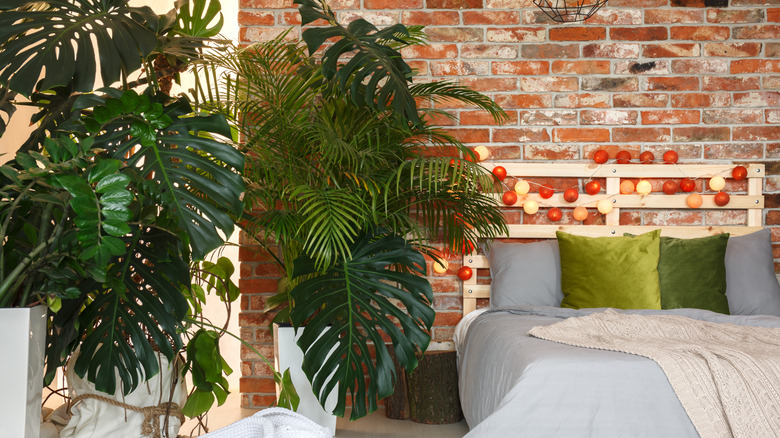
The trick is to use enough greenery to interrupt a sightline rather than trying to create a solid wall of leaves. So, start by identifying the sightline you want to break. For example, you may want to separate the dressing area from the bed. Once that's settled, put three to five tallest plants in a row, leaving roughly 20 inches between them. Bird of paradise, with its upright growth and wide, oar-shaped leaves, can be your go-to plant. A bold, structural fiddle leaf fig or snake plant would work well, too. When choosing between them, consider how much upkeep each needs and how much direct sunlight the area gets.
The same idea also works for windows. Position a few tall plants, such as areca palms, along them to create a loose green screen. This will give you some privacy without blocking natural light. Mix lighter and deeper shades of green so the plants layer together much like they do in the woods.
If you want to create a more substantial division, tall plants can handle that as well. Say you want to separate your workspace or reading nook from your bed; go for large-leaved plants like Monstera deliciosa. These plants can work as living screens because their big leaves shield the area from view, while gaps between them keep the space from feeling sealed off. Consider setting them on a plant dolly so you can roll them aside whenever you're redecorating or deep cleaning the floors.