

The Easiest Way To Remove Faucet Tap Stains With A Common Kitchen Staple
We may receive a commission on purchases made from links.
No matter how well you scrub your faucet taps while cleaning your bathroom or kitchen, they'll begin sporting unsightly stains within a few days, undoing all your effort. While you can compromise and make peace with the fact that they'll never be sparkling for more than a handful of hours, you won't have to if you reach for a common kitchen staple. Revealing the easiest way to remove faucet tap stains, Ashley Matuska Kidder, the founder and CEO of Dashing Maids, opens up to Hunker in an exclusive interview, "Vinegar is great for mineral build up and soap scum on faucet taps."
Elaborating on these primary causes, she says, "Hard water is the biggest culprit in staining faucet taps we see. When the water dries leftover minerals like magnesium and calcium are left behind. Soap scum and everyday toothpaste splashes are of course other common causes of staining on faucets." Since vinegar can cut through such crusty residue, this ordinary kitchen staple will help you say goodbye to hard water stains and soap scum buildup without much effort on your part. However, don't use it blindly since not all materials can handle its acidic nature. To elaborate, chrome taps can mostly handle vinegar, but stick to a soapy water solution for stainless steel, brass, and brushed nickel surfaces. Our expert further cautions, "Always be careful not to get vinegar on natural stone (your counters) and if your faucet is a specialty material be sure the manufacturer approves vinegar as a cleaning agent."
How to use vinegar to eliminate faucet tap stains
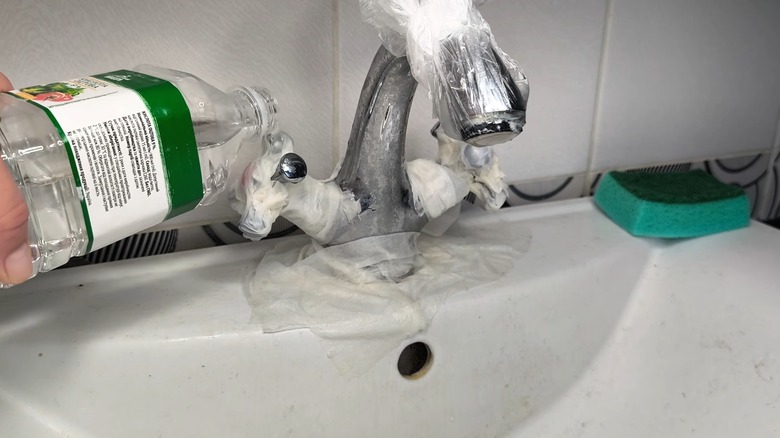
To easily clean and remove hard water stains, our expert recommends tweaking your approach based on the area you're targeting. She elaborates, "If it's the base or neck of the faucet you can mix vinegar and water 1:1 and soak a paper towel in it. Then, lay/wrap the paper towel around the areas that need to be cleaned and let it sit for 15 to 30 minutes." Ensure you cover your natural stone sink and counters with plastic wrap, an old microfiber cloth, or another impervious material to keep them from getting damaged. Though this may seem like extra work, regular contact with acetic acid will etch their surface and dim their natural sheen over time. So, don't take any chances and cover your tap's base sufficiently. Once the time is up, lightly scrub your faucet tap to make it shine like new.
On the other hand, "If the build-up is in/around the faucet, you can fill a plastic sandwich bag with the vinegar/water mixture and tie it to the faucet with a rubber band," opines Matuska Kidder. Make sure you tie it tightly, or the bag might give into the pull of gravity and slip off before the buildup loosens enough. And while it may not involve as much scrubbing, you'll have to leave the bag tied around longer than the previous method for the best results. Sharing an alternative method, she mentions, "You can also use a toothbrush to scrub baking soda on the affected areas to gently lift away minerals and soap scum. Rinse it with water and wipe dry with a clean microfiber towel."
How often you should clean your faucet taps to keep them sparkling
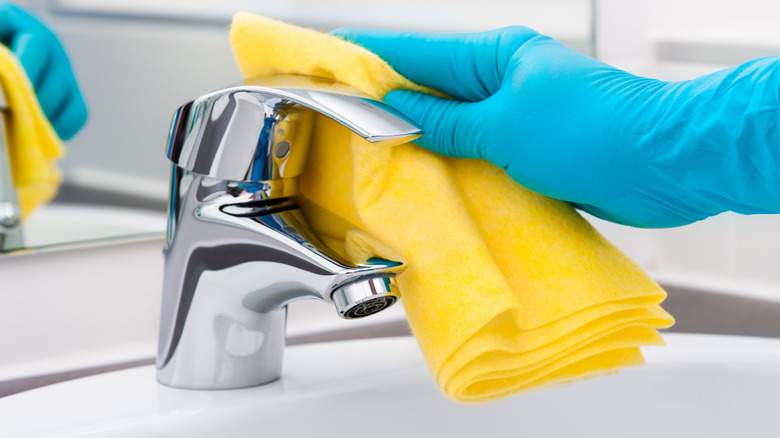
Even though vinegar is a powerful cleaner, irregular applications won't be enough to keep your faucet taps stain-free forever. So, to keep them at bay, our expert proposes, "If you can wipe the faucets with a microfiber towel and all-purpose cleaner once a week you will stay on top of combating build-up and keeping it at bay. This will greatly reduce the need for stain removal and big cleaning tasks." But if you'd rather not spend all your weekends cleaning the fixtures around your home, keep a microfiber cloth underneath your sink and wipe down your taps after each use. In case that seems too excessive, try wiping them down at least at the end of the day. Your goal is to keep water droplets (especially if you're dealing with hard water) from drying on or around your faucets. Don't forget to dry the cloth after each use, or it'll turn into a breeding ground for bacteria and give off a musty smell.
And while you'll mostly find white limescale spots around your fixtures, you may have to use something a bit stronger than vinegar to eliminate other kinds of stains. Shedding light on them, Matuska Kidder states, "Other types of water may cause orange or brown rust stains to build up from iron." In such scenarios, a specifically formulated Calcium, Lime, and Rust Remover, such as this spray from CLR Brands, might be more appropriate. However, if it's been a while since your last cleaning, "Bacteria and mildew can build up around the base where water sits. It will appear pink or black," she warns. Vinegar is generally enough to remove such growth from around your faucet taps.