

Forget Concrete Blocks: The Sleek And Durable Alternative For Retaining Walls
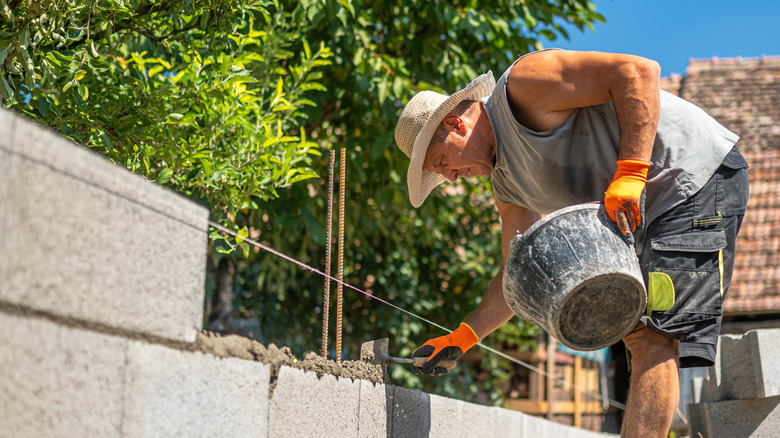
If concrete blocks in your retaining walls are cracking, staining, or starting to crumble, know that it's not unusual. Even though they're often the default material for such projects, a few seasons of rain, frost, and sun take their toll over time. Not to mention that these look incredibly plain. So if you're building a simple retaining wall for your garden, basalt stones are a better choice. These dark volcanic stones are dense and durable, so they hold up even in harsh weather without requiring yearly repairs.
Durability is just one factor, though. Basalt is also aesthetically pleasing, with its colors ranging from deep gray to black and a dense texture making it a good idea for rock landscaping. An added plus point is that the stones' dark color pairs especially well with the plants in your garden, making your flowers stand out. But the bigger basalt boulders are heavy, weighing anywhere between 100 and 200 pounds each. Even the medium-sized ones tend to be heavy, weighing from 70 to 100 pounds. So, if you're thinking of DIYing a retaining wall, think again. You'll need professional help and heavy machinery to lift the stones into place. Steep corners or stairs will also be difficult to cover if you don't have prior experience. However, if this will increase the cost of the project and you want them stacked in neat rows, stick to smaller, unfinished basalt rocks. But since they weigh between 15 and 70 pounds, be sure to enlist the help of a friend or two.
How to build basalt retaining walls
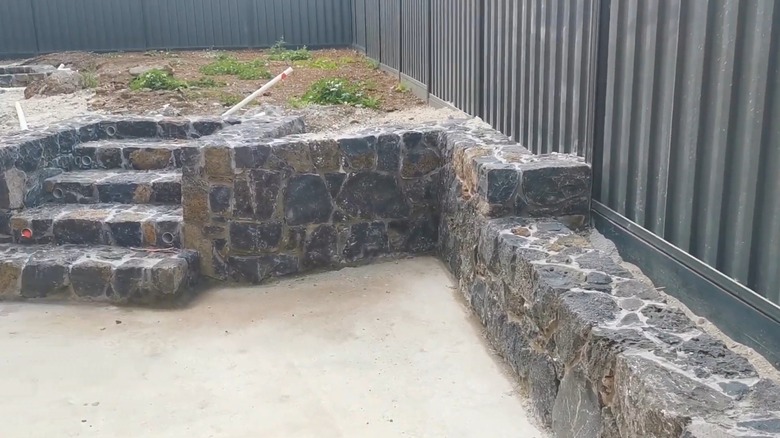
Even if you choose smaller stones, you can safely DIY a 24-inch tall retaining wall, as anything taller needs a professional's expertise for safety purposes. To start, mark the desired area with a stake at each end, then tie them together with a string. This will tell you where to dig. Next, lightly water this patch to minimize dust particles getting airborne and dig a trench about 4 inches deep and 24 inches wide with a shovel. Set aside the dug-up soil in one of the tools used in site preparation, like a wheelbarrow, to use it later as a natural binding agent.
Now, place the basalt stones close together from one end, with the flat side facing upward. This will make it easier to put the next layer of stones on. Once done, apply a little dug-up soil with a shovel behind the first row of stones. Then, press the soil into the crevices between the stones, filling the gaps. For a snug fit, tap each stone with a hammer until it settles into position.
Once the first row is set, build the second. Here, stack the stones like bricks in a wall, securing each stone over a gap in the row below, so the joints in the two rows don't line up. Continue along the wall, staggering each joint as you go. Also, tilt the wall slightly inward as you build. Set each new row a little farther back toward the soil, so that the wall leans inward by 1 inch for every one foot of height. Finally, use the remaining soil to backfill the wall using a shovel. And that's it: a wall that stands up to rain, frost, and sun, and gives your flowers a sleek, dark backdrop.