

Give Old Basement Stairs An Adorable Upgrade With This Low-Cost DIY
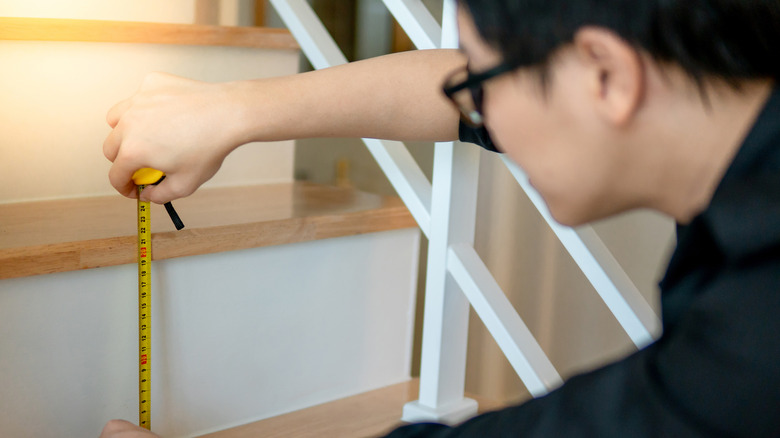
Unfinished wood basement stairs, while practical, typically add nothing to your home's aesthetic value. While finishing the entire basement may not be in your immediate budget plan, it doesn't mean your stairs have to stay in their current utilitarian state. Facebook user Lex Unsupervised shared how she gave her wood basement stairs an affordable upgrade by painting the outer portion, then adding a center runner made up of two smaller, affordable rug pieces for a custom-looking transformation.
By using a plush carpet pad for comfort and disguising the seam between the two rug pieces, she was able to give her stairs one long, inexpensive carpet runner. Considering you can find plenty of long runner rugs online — i.e., 10- to 12-foot, like the Dakota Fields Humphrey Southwestern Gray 10-foot Runner Rug on Wayfair used by the Facebooker — for less than $50 each, runner rug pads for about $25 each, and a gallon of paint for around $50, you can create a high-end-looking carpet runner on your basement stairs for roughly $200. Alternatively, you could repurpose an unused 8x10 or 9x12 rug pad (cutting it down to size) you already have on hand, and use existing paint to save more.
The premise of this basement staircase makeover is simple, requiring only a little elbow grease, paint, carpet pad(s), a pair of runner rugs, and a staple gun. To prep for the project, clean up the unfinished wood basement stairs as needed, scraping and sanding so the treads and risers are paint-ready. Then it's time to elevate your basement stairs with a cushy, upscale-looking custom runner makeover that's cost-effective.
Calculating the runner length you'll need for your basement staircase
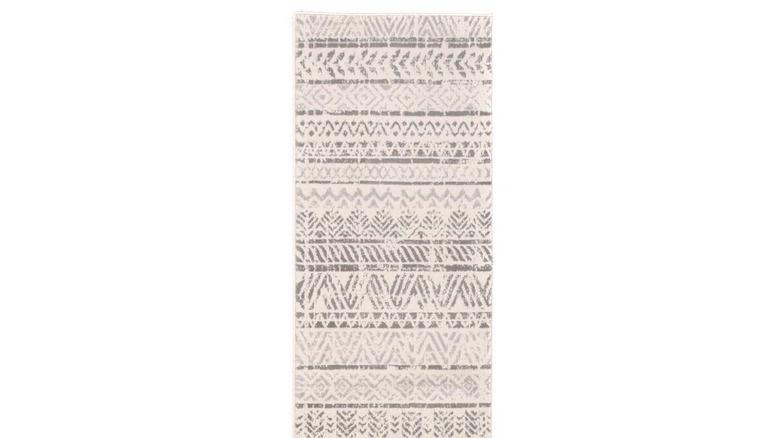
Before you begin this basement stair project, you need to select a pair of runner rugs to match your home's aesthetic. A patterned option, especially one in medium or dark shades, will help hide wear, tear, and dirt, and disguise the seam where the two rugs connect. Still, the final look is completely up to you.
Here's where a little math comes in to determine how long of a runner you'll need. A standard residential stair tread — the flat part you step on — is between 10 and 11.5 inches deep, and a standard home stair riser — the vertical portion between treads — is around seven to 7.75 inches high. This means that for every tread-riser combo, you will need to plan for about 17.75 to 19.25 inches of runner. Most people can safely use 19 inches as a good benchmark for calculating, but if you have large stair nosing — the overlapping rounded front cap at the front of the tread — you may want to bump this number up by an inch or two to be safe.
Next, you will multiply this figure by the number of stairs you have (plus one additional riser) to get the project's total runner length. A basement with a standard eight-foot ceiling requires about 13 to 15 steps to get to the upper floor, meaning you'd need somewhere between roughly 20.7 and 25.7 feet of runner rug length, depending on your actual stairs. When in doubt, always round up to make sure you have enough material to work with.
Painting the steps and installing your basement stair runners
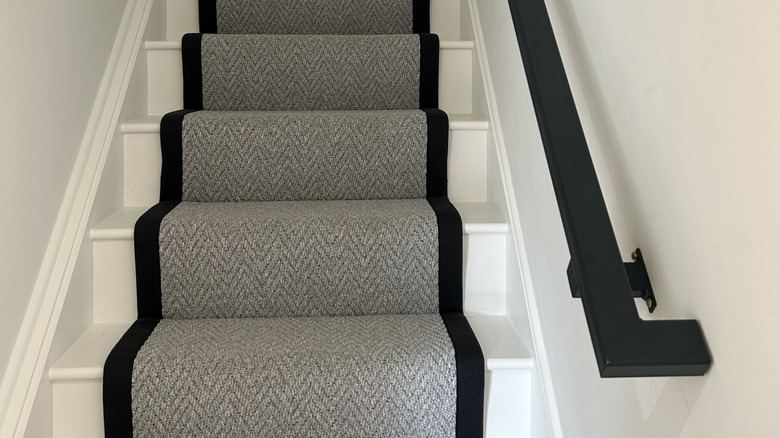
Using the center point of the stair tread as your middle point, mark your runner width on each tread and riser. Run a line of painter's tape about an inch inside these markings on each side to ensure the rug will overlap the paint. Using a satin or semigloss paint (easier sheens to wipe and keep clean), paint the outer portion of the stairs that'll be exposed. The Facebooker chose to paint hers black, but you could also match your trim color or choose a fun accent color for a little pizazz.
Next, cut your plush stair rug pad two inches narrower than the runners – the same width as the unpainted strip down the middle of your stairs, which you can use as a guideline to center the pad. Beginning at the top of the uppermost riser (under the nosing from the first floor), staple the edge of the rug pad in place in several spots on each tread and riser, seaming pieces together as needed at a corner and terminating where the bottom riser and basement floor meet.
Repeat this same process with the runner rug, centering it over the rug pad so the edges overlap onto the paint. When you're running out of the first rug piece and can no longer cover a whole riser-tread, plan for the transition at the top of a riser so that the nosing above helps disguise the seam. Leave an inch or so of overlap on the first piece, cutting it, folding it under, and stapling the whole thing securely to the riser. Then, start the new piece at the top of the riser, overlapping the old piece to cover the end, and proceed with the process until reaching the bottom of the staircase.