

Do You Still Need To Balance A Mower Blade After Sharpening It By Hand?

We may receive a commission on purchases made from links.
As co-owner and head go-fer for a garden and landscape business in the 1990s, it was my job to keep the blades of our two rotary mowers sharp. Being pretty low tech at the time, I didn't have any of the smarter tools available today that allow you to sharpen a blade in place, so I would typically remove the blade to sharpen it. I'd put it in a vise, and do the job with a rotary tool or a file. When the blade felt sharp, the next step was always to remove from the vise and balance it.
Even when you're sharpening with a file, it's all too easy to remove more material from one end of the blade than the other. Ideally, you want to sharpen each end equally, but when nicks and gouges force you to focus more on one end of the blade, it can be difficult to duplicate that on other side. But if one end ends up being heavier than the other, the blade is going to wobble when you're using it.
A wobbly blade on a lawn mower is a bit like a loose wheel on a car. It creates vibrations that force the engine to work harder and waste energy, shaking other components loose in the process. Plus, it's uncomfortable, and it takes more effort to control the machine. A wobbly lawn mower blade also does a poor job of cutting the grass — pulling, shredding, and leaving it looking uneven.
Blade balancing options
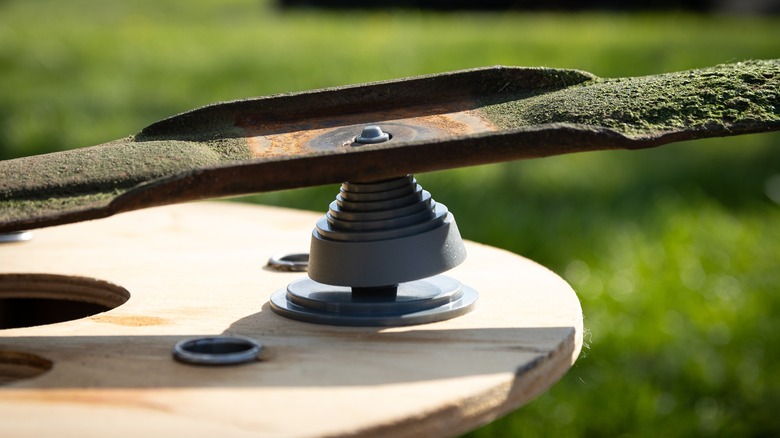
In my business, I used a simple blade balancing strategy: I drove a 3-inch screw about halfway into a wall stud in my shed, hung the blade on it, and let gravity do the work. Not only did this method tell me which side was heavier, it told me by how much. Most of the time, one side would dip by less than an inch, making it fairly easy to shave a bit off that end and achieve horizontality. A blade that dipped more than that was typically old and well-used, and usually needed to be replaced.
These days, I use a balancing cone, which is a more accurate balancing method. It's a metal or plastic cone that sits on a pinion attached to a flat base, and when you put the blade on it, the heavier side falls lower than the lighter side. It works on the same gravity-driven principle, but the cone is portable and doesn't call for defacing your wall with screws. Cheap versions, like the Hesengshidai 42-100 Precision Mower Blade Balancer ($5.99) need to be on a flat surface. If you prefer to mount the balancer on the wall, you can opt for a more expensive (and more accurate) magnetic one like the SporGain Lawn Mower Blade Balancer ($29.99).
Frequent cleaning and proper blade care extend the life of the mower. When you're having trouble balancing a blade, it's usually near the end of its service life and either needs professional sharpening or replacement.