

DIYers Hide Unsightly Downspouts With A Smart Design
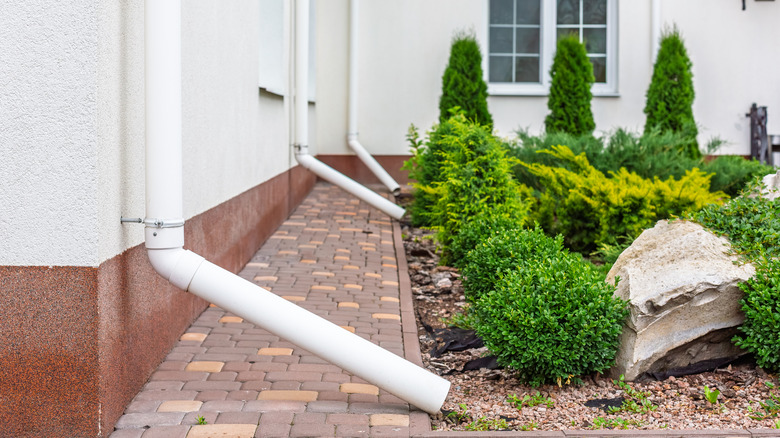
Downspouts are important for funneling water off your roof and away from your home, but they are certainly not pretty. The main portion of the downspout is typically plain white, which is a little lackluster. However, the end is where the main problem presents itself. Since the water flows over the same place and in the same direction as it exits the downspout, it can wear away the ground in that area. This could lead to erosion, or even foundation an structural issues. If you're tired of dealing with unsightly mud puddles around the end of your downspout, DIYers like Youtuber Jesse Smith have a nifty solution. He attached a pipe to the end of his downspout to carry the water further away, then hid the extra pipe by burying it. If you want to try this out for yourself, you'll need a flexible plastic pipe, some waterproof tape or PVC glue, and a shovel. You may also want some extra soil, grass seeds, and decorative stones or plants.
The pipe should be roughly the same size as the downspout and fairly durable. A corrugated or PVC pipe typically works well for this DIY. Additionally, while you can just fit the pipe over the downspout and glue it in place, a downspout adapter will make the process easier. Opt for one with a cleanout opening to make maintenance easier as well. Since you'll need to dig up part of your yard, there will be some cosmetic damage to your lawn. Be prepared to reseed it or hide it with other decorative elements. Additionally, you should clean your downspouts first to ensure you don't have any nasty surprises while you work.
Burying your downspout
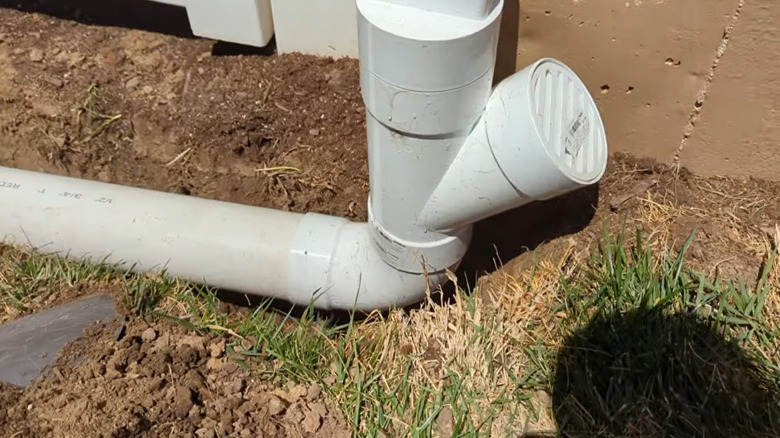
Start by measuring where the pipe will sit, taking into account the height between the end of your downspout and the depth you'll be burying the pipe at. Double check the location of any utilities in your lawn as well. In order to flow properly, the pipe will need to run downhill. If your lawn is mostly flat, you may need to create a slope. (Lawn grading and resloping can be quite technical so ensure to do your research well before starting.) Don't forget that the end of the pipe will need to be somewhat exposed to let the water flow out. Choose a spot that's less visible to avoid any aesthetic issues or you could combine this DIY with another by planting a rain garden around your downspout.
Once the path is plotted, start digging your trench. If you remove the top layer of grass carefully, you may be able to set it back into place afterwards to disguise the trench. It should be at least deep enough to cover the pipe entirely, with no part above the surface. If it's right at surface level you risk the pipe being damaged by the elements or activity above it. Place your pipe into the trench and connect it to your downspout. Carefully fill in the dirt around the pipe, leaving the far end clear. You can add a grate covering or pop-up drain to the end if you prefer. Reseed the lawn if necessary. You now have a DIY downspout disguise that lets you avoid those unsightly mud puddles and bare patches.