

How To Reuse Old Lawn Mower Blades For A Helpful Garden Tool
We may receive a commission on purchases made from links.
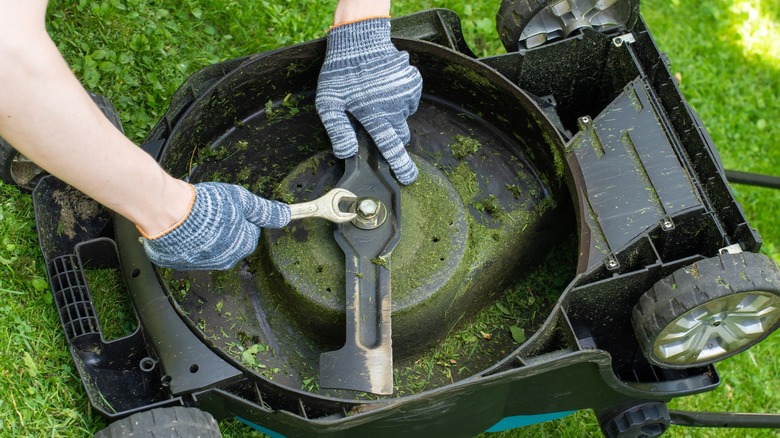
You have the loppers, the shears, the 20-horsepower grass-cutting machine. But sometimes what you need is a weighty knife, for clearing brush, perhaps, or cleaning up vegetable garden vines at the end of the season. Fortunately, lawn mower blades can do a lot more than cut grass, and when yours is too worn out for trimming the lawn, you could transform it into a useful tool that isn't necessarily in every gardener's vocabulary. What you need is something like a heavy machete or a parang, a tool that's similar in size and weight to a mower blade.
Making a proper parang — a tool proportioned like a machete but heavy like an axe — from a mower blade is possible, but it requires some metalworking knowledge and tools. This doesn't mean you have to become a blacksmith, out on the edge of the village with your dog Ping and probably some beard oil, but it does require some unique equipment. Blacksmithing requires that metal be heated in a forge and beaten relentlessly while poor Ping hides in the woodshed. You'll also need blacksmithing tongs, gloves made of those heat-resistant tiles from the space shuttle, an anvil, and a hammer that will soon seem impossibly heavy to you. If that seems beyond your scope, though, you can also make a heavy chopping knife that does the same work but is slightly smaller and slightly less durable. For this, all you need is an angle grinder and perhaps a belt sander, along with the usual complement of discs and belts for them.
Turning a mower blade into a knife without a forge
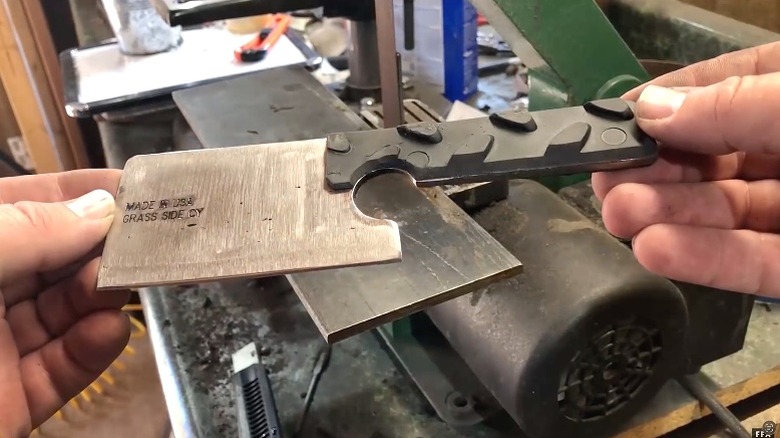
We'll be modeling our simpler knife-making approach on the fine example of YouTuber FargoFX, who makes a cleaver-style knife from a mower blade with no forging or heat treating. In this tutorial, the only expense was a Western Safety Self-Adhesive Rubber Safety Mat from Harbor Freight that works as the comfort grip. Alternatively, you can also use more traditional paracord, jute twine, or rope, adding athletic tape or silicone tape, if desired, to build up the grip. You will also need eye protection and a respirator.
Since you're not forging, you'll be restricted to the mower blade's flat center section, limiting the knife's size. Install a cutting wheel on an angle grinder, and cut off the mower blade's curved ends. Roughly shape the flat part into a knife shape, making sure to cut one end into a handle that is ideally 4 to 5 inches long.
With a grinding wheel on the angle grinder, work your steel closer to its final contours. Shape the blade's cutting edge with the grinder, or use a metal file, a bench grinder, or a belt sander, just as you might normally sharpen lawn mower blades. Be gentle and take frequent breaks; overheating the blade can cause it to lose its factory temper and weaken. Once any part of the steel gets too hot to handle, dip it in water to cool it before continuing. Put a flap disc on — you guessed it — your angle grinder to clean the metal, and use the belt grinder with a fine grit to put a final edge on the blade.
But what about actually blacksmithing a new knife?
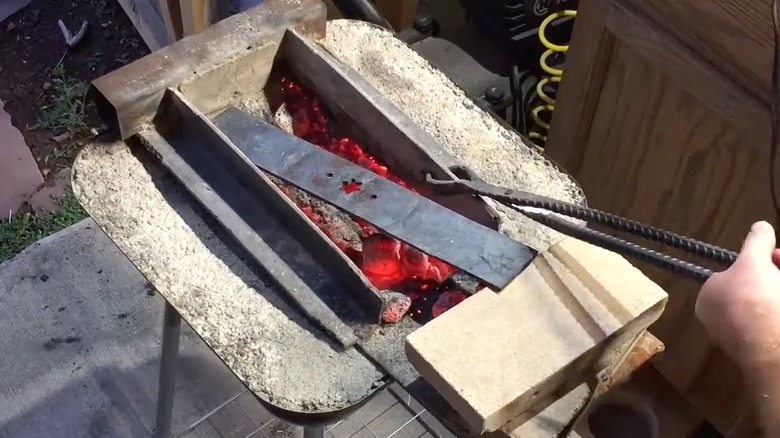
The steel from which standard mower blades are made has a 40 to 50 Rockwell hardness ... okay for what it is, but pretty poor for a knife. You can improve its original hardness and temper somewhat by properly forging, shaping, and finally quenching the steel as you work. YouTuber averageiowaguy outlines the process, using an at-home forge setup to DIY a parang knife from an old mower blade. You'll find small forges for relatively little cost, like this VEVOR Portable Propane Forge at Home Depot that runs roughly $75, while an inexpensive anvil runs about $30 to $50. Other than that, you'll need PPE, standard forging tools, and, weirdly enough, warm peanut or canola oil for quenching the steel. (Note that it is possible, though not ideal, to heat treat steel at home with a propane torch.)
The basic process to convert your mower blade to a knife involves heating it in your forge, taking it to the anvil with your tongs, and hammering it flat. Draw and cut the rough shape of your ideal garden knife from this blank. For this, averageiowaguy uses a rotary tool, which suggests he has a level of patience you do not wish to possess (you can use your angle grinder for an easier time).
After roughly shaping your knife, heat it in the forge again, and continue to shape the blade until you're happy with it. Heat the steel to its Curie temperature, at which it will no longer be magnetic, and then quench it. You can then carve or sand a wood handle, attaching it to the knife with rivets. Or, follow FargoFX's easier path, and cut the shape from that stair tread material and stick it on.