

The Ultra-Rare Vintage CorningWare Pattern You'd Be Thrilled To Find At A Thrift Store

We may receive a commission on purchases made from links.
Who knew CorningWare was for the birds? Some of the brand's hardest to find and priciest patterns feature our fine feathered friends. The simply named "Duck" may be one of the most valuable CorningWare patterns to look for at a thrift store. That pattern has a single, speckled mallard duck on the front of a casserole dish and should have a tinted glass lid. But another entry into CorningWare's birds of a feather catalog is the Game Birds pattern, which is an ultra-rare find.
Not too much is known about Game Birds, except that it's actually a series of several designs, each of which features a different fowl. The pattern most likely dates from the 1960s and was produced into the 1980s. It seems to be Corning's attempt to cash in on a trend, as multiple brands used the exact same transfer designs on their dishware.
Who might you see flying across a CorningWare Game Birds dish? There's a teapot (model number P-104) that has four different birds on it — pheasants, mallard ducks, Canadian geese, and partridges. A P-16 skillet also exists with the pheasants, as do several casseroles with the flying ducks pattern. The Game Birds pattern also coordinates with Corning's Centura dinnerware, which is made of the same Pyroceram material as CorningWare and predates Corelle dinnerware. If you come across a casserole dish with this pattern at the thrift store, it could potentially be worth $300 to $400.
Hunting down Game Birds at the thrift store
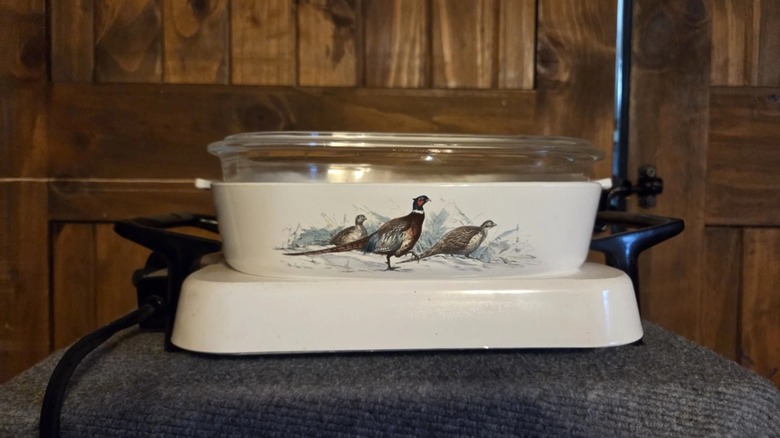
For whatever reason, game birds printed on dishware were a big deal in the mid-20th century. Corning wasn't the only brand to tap into the demand for ducks, geese, and other fowl on dinnerware, teapots, and casserole dishes. Companies like Hall China and the prestigious Crown Staffordshire bone china used the same transfer patterns as Corning to produce plates and other dishes featuring geese, ducks, pheasants, and so on.
That means you need to have a keen eye and some familiarity with CorningWare when hunting for the Game Birds pattern at your thrift store. First, get to know Corning's pieces, such as the P-16 skillet, which may or may not have an electric warming tray along with it, and the TK-2 Cookmates Tea Kettle, which is different from the P-104 6-cup teapot. Also familiarize yourself with CorningWare's back stamps, as these will help you determine if the piece was actually made by Corning and the general time period of production.
Earlier pieces, from the 1960s, will have a printed mark on the bottom that reads "CorningWare," "Made in the USA," and contains details about the size and model number. In the late 1970s and early 1980s, CorningWare started using a squared off "block" style stamp that contained all the pertinent details. In the 1980s, the back stamp became embossed and the company began using metric measurements. Dinnerware from Centura that featured Game Birds also included facts and details about the birds depicted on the front.